 Subscribe Now



Word on the street > 27 Takeaways from The CEO Symposium; How Each Kind of CEO Can Help (Or Hurt) Strategic Planning
Word on the Street: Issue 288
Weekly real-time market and industry intelligence from Morrissey Goodale firm leaders.
Takeaways from The CEO Symposium

Last week, 80 AE industry CEOs gathered in Dallas for The CEO Symposium. The symposium kicked off on Wednesday evening with a reception at the HALL Arts Hotel followed by nine small group CEO networking dinners at some really nice Dallas Arts District restaurants.
Following a power networking breakfast the next morning, the day continued with a thought-provoking panel on “The Future of the AE Industry” with Gayle Packer, CEO of Terracon (Olathe, KS) (ENR #19); Mike Carragher, CEO of VHB (Watertown, MA) (ENR #65); and Mike Renshaw, CEO of Trilon Group (Denver, CO). It was then on to a first series of roundtable discussions covering topics such as AI; industry M&A and capitalization; and growth, strategy, and succession. After a quick photo break (see below) and networking lunch, it was on to a deep-dive panel on one of the hottest AE markets—data centers—featuring the CEOs of two prominent data center designers (coincidentally both based in Dallas), Corgan (ENR #41) and AG&E (ENR #356). Then the day wrapped with a second set of roundtable discussions on anticipated changes in the areas of workforce, clients, firm operations, and the very nature of the role of the CEO.
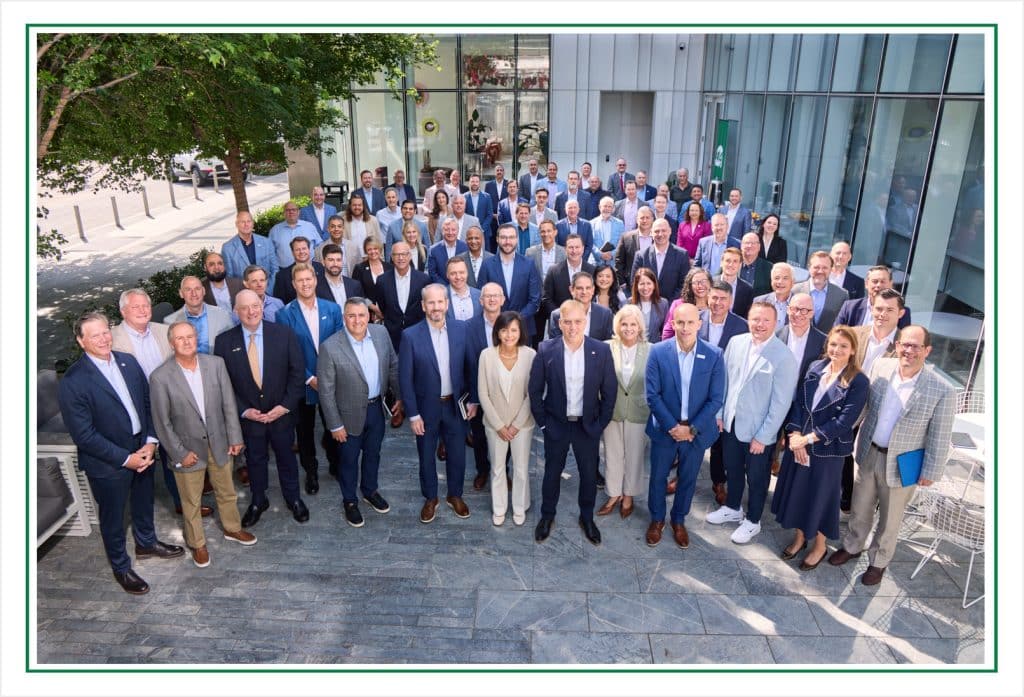
The 2026 CEO Symposium Attendees and Hosts
Here are 27 observations from last week’s symposium from some of the Morrissey Goodale dinner hosts and roundtable discussion moderators.

Katharine Van Leer (Durham, NC)
 Connect with Katharine on LinkedIn
- The world is our “data center” oyster: One big takeaway from the panel on the “Ins and Outs of the Data Center Market” was that the rest of the world is years behind, and the U.S. will continue to dominate data center design for the foreseeable future.
- Communication is key: CEOs from small to very large firms are rethinking how they communicate with their employees by prioritizing increased visibility at the top, greater transparency around financials, regular updates on firm health, and progress on initiatives. Many are doing this through monthly and quarterly all-team meetings, as well as investing in large-scale, in-person retreats for shareholders each year.
- One is the loneliest number: Although many CEOs rise through the ranks alongside peer leaders, when they reach the top role, they often find themselves without a peer group to confide in about the challenges of leading a firm. Morrissey Goodale’s CEO networking dinners gave attendees the opportunity to unwind, speak openly, and compare notes with fellow industry leaders. Bonds were forged, plans were made, and everyone left with new connections.

Brendon Cussio (Denver, CO)
Connect with Brendon on LinkedIn
- AI—Buy it, don’t build it…yet. While it’s more expensive to buy, it’s faster to implement and doesn’t require hiring folks for whom we aren’t used to searching or having on staff.
- Growth—Growing firms self-create opportunities for leadership transition as more positions open for rising stars. Additionally, new positions don’t have to have a preconceived framework. It’s about the characteristics of the individual required to be most successful in the role.
- Talent—The industry is shifting from hiring technical excellence to emotionally intelligent, creative thinking, utility players who can play multiple roles within the organization.
- The CEO of the future is not one who is focused on operational excellence, but one who is an inspirational leader, an early adopter of technology, and a user of excess capacity to be creative, innovative, and focused on company culture.

Nate Wentworth (Denver, CO)
Connect with Nate on LinkedIn
- AI is driving efficiency today, but revenue generation is still evolving. Firms are actively using AI across proposals, data management, contract review, and workflow automation, with clear ROI from time and cost savings—but most have not yet cracked how to directly monetize these capabilities with clients.
- Data strategy is emerging as the key competitive advantage. Firms investing in structured data, centralized platforms, and dedicated data/technology leadership are better positioned to scale AI and unlock broader enterprise value.
- Adoption is mixed due to both internal skepticism and client constraints. Mid-career professionals remain cautious about reliability while early-career professionals remain concerned about job security. Certain clients—particularly utilities—are resistant to AI usage due to confidentiality and data privacy concerns, limiting full deployment.
- M&A pressure and industry evolution are forcing stronger operations and earlier succession planning. Sustained consolidation and increased private equity presence are pushing firms to focus on growth, talent, and performance—professionalizing the industry more than ever before—while highlighting that delayed ownership transition remains a major challenge for the industry.
Rex White (Charlotte, NC)
Connect with Rex on LinkedIn
- Consolidation is reshaping the industry, and some firms don’t even know it. One hypothesis for a contributing factor to the sell-side supply squeeze: Small, founder-led firms remain heads-down getting the work done, unaware of the market conditions shifting around them. When they finally look up, the industry they see may not be the one they remember.
- Tech investment is no longer a line item, it’s a strategic bet. One platform-level firm has increased technology spending fivefold in recent years and is building dedicated onshore/offshore AI development teams. Another major firm reported that this is the first year their technology spend outpaced facility investment. The leadership challenge was framed sharply: The right person to lead innovation is the one it hurts to pull off billable work, and that pain is exactly the signal you’ve chosen correctly.
- Delayed leadership transition remains the industry’s most underestimated risk. Multiple sessions surfaced the same theme: Firms are navigating record CEO transitions without adequate preparation. The consensus was that succession must be about broad leadership development, not one-for-one replacement. The message was blunt: Start the conversation early, before a crisis forces it. The firms navigating this well share a common trait—a culture of stewardship, not just a succession plan.
- The firms that will lead are the ones willing to be uncomfortable. Across multiple sessions, one theme surfaced more than any other: Willingness to change is the differentiator. CEOs described the need to be OK with uncertainty, run more experiments, and embrace a culture of problem-solving rather than process protection. Customer intimacy was cited as the final competitive moat, replacing scale and technical depth as the primary advantage.

Matthias David (Chicago, IL)
Connect with Matthias on LinkedIn
- AI is optimizing before it transforms. The current use of AI in the AE industry is still largely focused on making established processes more efficient rather than reshaping operating models across the industry…at least for now. CEOs are facing the challenge of pursuing a wait-and-follow approach or taking a bet by building early and hoping to lead.
- Talent remains the industry’s biggest pressure point. The talent shortage continues to be the number-one issue keeping CEOs up at night, intensified by an unsustainable cycle of firms poaching from one another. Many leaders are looking to AI as the potential holy grail to improve capacity and productivity, though whether it delivers meaningful relief remains an open question.
- Skills of the future are less technical and more human. Developing communication and people skills within the workforce is rising on CEO agendas as firms look to build deeper trust with clients. In a world where AI may increasingly level technical expertise, trust is becoming the currency that keeps firms differentiated.
- Strategy and growth are about alignment and readiness. Successful growth starts with clearly advertised goals across the firm and building the company now that you need for the future in terms of technology, people, and leadership.

David Thornhill (New York, NY)
Connect with David on LinkedIn
- AI is proving to be less about “change management” and more about transition management: Firms are not preparing for disruption, they are already navigating fast-moving whitewater in real time, adapting on the fly because opting out is no longer a realistic choice.
- “Single throat to choke” may not win any HR awards, but the underlying lesson resonated: accountability, authority, and responsibility work best when all clearly belong to the same person.
- Not everyone agreed, but there was a growing sense that the AI era may resemble the shift to drone warfare: Smaller, faster, more adaptable players can compete far above their weight class because they are less constrained by legacy systems and entrenched ways of working, creating a potentially significant threat to established industry leaders built for a different competitive environment.
- AI may create opportunities for greater efficiency, but several participants cautioned against automatically giving those gains back through lower fees; in an industry long conditioned toward pricing on cost rather than value, one comment resonated: “Fees are like gravity. Someone has to push back on them.” AI expands strategic choices, but it does not predetermine the outcome.

Nick Belitz (Denver, CO)
Connect with Nick on LinkedIn
- AI is a game-changer for improving efficiency and production time for the industry, but it is NOT a reason to stop hiring or slow recruiting and retention efforts.
- The best applications of AI agents come from the design professionals and people using the data and output each day and NOT the IT or AI professionals in the organization.
- And with competitive pressures as high as they’ve ever been in the AE industry right now, CEOs are honing the value propositions of their firms around that which is distinctly human—the trusted advisory, the judgment, and the true consulting to clients that are critically needed.
- The quicker firms can get away from filling out timesheets and simply selling hours for money, the more firms will be recognized for delivering true value to the people and communities the industry serves.
Our goal for the symposium was to be the best 24 hours of networking and learning for all 80-plus of the CEOs involved. If we got close to achieving those two goals, it was 100% because of the candid and open exchange of ideas throughout the course of the event.
The 2027 CEO Symposium will be held at the beautiful Post Oak Hotel in Houston next May. We hope to see you there!
How Each Kind of CEO Can Help (Or Hurt) Strategic Planning

Facilitating strategic planning sessions in AE firms is interesting because the room is always filled with very smart people who are highly capable in their own lanes, but who often approach decision-making very differently. And nowhere is that difference more visible than with the CEO.
Some CEOs dominate the room without realizing it. Some barely speak until the very end. Some want consensus on every issue. Some are impatient with discussion altogether. Some think in terms of markets and positioning. Others think in terms of people, culture, and trust. Some are emotional. Some are analytical to the point where the conversation can feel like a lab experiment.
None of these styles are inherently bad. In fact, most successful CEOs became successful because their style fit the firm at a particular point in its growth. The problem is that strategic planning often requires CEOs to operate differently than they do in normal day-to-day management.
Running a firm and facilitating good strategic thinking are not the same thing. A CEO who is highly effective in operations can accidentally damage a planning session. A quieter CEO can unintentionally create confusion or lack of direction. A collaborative CEO can let the process drift. A decisive CEO can shut down useful disagreement too early.
The best planning outcomes usually happen when the CEO understands two things:
- What the room actually needs from them during strategy discussions
- How their natural style affects the room
The Powerful or Alpha CEO
I’ve seen my share of these leaders. They often founded the firm or rescued it during difficult years. Sometimes they are simply exceptionally strong personalities with tremendous confidence and industry credibility.
These CEOs tend to move fast, speak first, and carry enormous influence in the room. People naturally look to them before offering opinions. Even when they are trying to create open discussion, others often measure their comments based on how they think the CEO will react.
The challenge is their gravitational pull. When a CEO has enough authority, intelligence, experience, or force of personality, the room can slowly stop thinking independently. Participants begin editing themselves in real time, ideas become filtered, and debate narrows. I have observed many discussions that shift from exploration to “Where does the CEO want this conversation to end up?” That’s a potentially dangerous dynamic in a strategic planning setting because firms rarely improve when no one dares say the “wrong thing” in front of the CEO.
The most effective alpha CEOs in planning sessions do several things intentionally:
- They speak later, not earlier.
- They ask more questions than they answer.
- They openly acknowledge uncertainty.
- They allow disagreement to remain on the table longer.
- They avoid summarizing too quickly.
One of the most productive things a strong CEO can say in a planning session is, “I’m not sure yet.” That simple statement gives everyone else permission to think instead of simply align.
It also helps when these CEOs separate discussion from decision. It’s easy for people to assume that every comment from the CEO is an immediate directional signal. But good strategic planning works best when people feel free to explore ideas before trying to determine where the CEO already stands. Otherwise, the conversation becomes overly cautious and politically filtered.
The irony is that the strongest CEOs often improve the room most when they deliberately use less force.
The Decisive CEO
This CEO is usually operationally strong and highly respected because they make decisions efficiently. These leaders dislike ambiguity lingering too long. They tend to believe that clarity creates momentum and momentum creates organizational health.
And they are not wrong.
The problem is that strategic planning sometimes requires sitting in ambiguity longer than feels comfortable. The decisive CEO often creates trouble when they force premature closure on issues that need further exploration. They may hear 20 minutes of discussion and conclude, “Alright, we know what we need to do here.” Sometimes they do, but just as often, they don’t.
In AE firms especially, decisive CEOs can unintentionally reduce strategic discussions to operational fixes. Instead of exploring larger positioning questions, the room starts solving immediate execution problems. For example:
- A market diversification discussion turns into staffing allocation
- A long-term technology discussion turns into software purchasing
- A conversation about leadership succession turns into organizational chart revisions
Those are important issues, but they are not strategy.
The decisive CEO contributes best in planning sessions when they focus on pacing rather than closure. That means:
- Helping the group avoid endless circular discussion
- Clarifying tradeoffs
- Identifying where decisions are actually needed
- Separating strategic issues from operational distractions
- Keeping the group moving without rushing the thinking
These CEOs are often excellent at helping the group convert broad discussion into practical direction. The key is timing. If they do it too early, they limit thinking. If they do it at the right moment, they create momentum and clarity.
The Collaborative CEO
This leader usually values inclusion, alignment, and team cohesion. They often create strong cultures because people feel heard and respected, and they tend to be well-liked internally. Employees often describe them as approachable, thoughtful, and fair.
The risk collaborative CEOs come with is over-democratization. They sometimes unintentionally blur the distinction between listening and leading. The planning session becomes an effort to make everyone comfortable rather than an effort to identify the best long-term direction for the firm. This style can create several problems, including:
- Difficult issues remain unresolved
- Strong personalities dominate informally
- Tradeoffs get softened into vague compromise language
- Strategic priorities become too broad
- The final plan lacks real focus
Many AE firms already struggle with excessive optionality. They want to pursue every market, retain every client type, preserve every office dynamic, and avoid disappointing anyone internally. But good strategy usually requires choosing.
Collaborative CEOs contribute best when they preserve openness while still creating directional clarity. They need to make sure the room understands that inclusion does not mean infinite flexibility.
A useful framework for these CEOs is:
- Hear broadly
- Debate honestly
- Decide clearly
- Commit fully
The planning process should absolutely surface multiple viewpoints. But eventually, leadership must establish direction.
The Emotional CEO
Some CEOs lead with visible passion, conviction, frustration, excitement, or concern. In AE firms, I’ve seen these emotions many times coming from founders or deeply mission-driven leaders who care intensely about the business and its people.
This style can actually be extremely valuable in planning settings because strategy is not purely analytical. Emotion, energy, and conviction matter.
The challenge arises when emotion begins driving the room rather than informing it. Emotional CEOs sometimes:
- React too strongly to disagreement
- Interpret questioning as disloyalty
- Shift direction based on recent frustrations
- Overweight anecdotal experiences
- Create unpredictability in discussions
People in the room start reading emotions instead of focusing on substance. One difficult client situation, for example, can suddenly become evidence that an entire market sector is broken. One disappointing leadership issue can turn into a broad conclusion about younger staff. Or one frustrating project can distort the firm’s overall strategic priorities.
These CEOs often contribute enormously when they channel emotional clarity into organizational purpose. They remind the group why the firm exists, what matters culturally, and what kinds of tradeoffs are unacceptable.
That perspective is valuable, but the room also needs analytical balance and enough emotional steadiness for difficult conversations to unfold productively.
The Stoic or Reserved CEO
This leader often says relatively little during discussions. They observe carefully, process internally, and typically avoid dramatic reactions.
In my experience, these CEOs are deeply thoughtful. Unfortunately, planning teams sometimes misread silence as agreement, disengagement, or lack of conviction.
The biggest risk with reserved CEOs is that people leave meetings unsure about what the CEO actually thinks. That uncertainty creates organizational hesitation later.
Reserved CEOs can also unintentionally allow stronger personalities to shape the room disproportionately because others interpret silence as permission.
These CEOs are often most effective in planning settings when they become slightly more transparent than feels natural to them. That does not mean becoming theatrical or overly expressive. It simply means helping the group understand:
- What concerns them most
- What they are weighing internally
- Where they see risk
- What principles matter most in decision-making
- When they are leaning toward a conclusion
Without that clarity, strategic planning can become directionally muddy.
The Analytical CEO
This CEO tends to approach planning through logic, data, benchmarking, and structured evaluation. They often excel at identifying weaknesses in assumptions and bringing rigor to discussions.
But analytical CEOs can create different problems. Sometimes the planning process becomes overly technical, overly detailed, or overly risk-sensitive. The discussion starts sounding more like a due diligence exercise than strategic leadership.
Common tendencies include:
- Over-analysis before committing
- Excessive demand for certainty
- Confusing data with strategy
- Overcomplicating decisions
- Focusing heavily on measurable factors while underweighting cultural or leadership dynamics
Some of the most important decisions firms make involve judgment under uncertainty, such as:
- Entering new markets
- Leadership transitions
- Geographic expansion
- Acquisitions
- Investment in emerging capabilities
- Brand repositioning
The room needs rigor, but it also needs movement.
The Best CEOs Adapt During Planning
The strongest strategic planning CEOs are rarely locked into one mode the entire time. They adjust, knowing when to facilitate discussion and when to establish direction. They know when to hold back and when to intervene, and they understand that the room sometimes needs openness and sometimes needs clarity.
Most importantly, they understand that strategic planning is not a performance. The CEO does not need to prove they already have every answer. In fact, the opposite is usually true. Good planning often starts when leadership is willing to openly acknowledge uncertainty, competing priorities, organizational strain, or changing market conditions.
That honesty improves the quality of thinking in the room.
Market Snapshot: Gas Tax Holidays
Weekly market intelligence for AE and environmental industry leaders.
With prices at the pump soaring by more than 50% since late February, calls are intensifying to suspend federal and state gasoline tax collections—which could jeopardize future transportation project financing.
National average gas prices reported by the U.S. Energy Information Administration have spiked from $2.94 per gallon on February 23 to $4.50 per gallon as of May 11, fueling gas tax holiday proposals to offer cash-strapped consumers relief. President Donald Trump last week joined calls for a temporary suspension of the 18.4-cents-per-gallon federal gasoline tax, which hasn’t been raised since 1993—back when Amazon was just a river and a rainforest. (The ubiquitous online marketplace was founded in 1994.) If enacted, drivers would save less than $9 a month, according to the Peter G. Peterson Foundation, but the lost revenue could prove disruptive to AE firms working in the transportation market.
Already, the federal gas tax fails to cover the U.S. government’s share of highway, bridge, and transit projects, and a moratorium could only deepen the funding hole. The Institute on Taxation and Economic Policy estimates a gas tax holiday would slash federal revenue by $2.4 billion monthly. With the Highway Trust Fund projected to go broke in mid-2028, the Committee for a Responsible Federal Budget estimates a fuel tax holiday that lasts six months would accelerate the depletion date to September 2027.
The road ahead for a federal gas tax freeze, however, is steep. The measure would require passage by Congress, which has never enacted a gas tax holiday. Outside Washington, however, some states have already taken action. Gas tax suspensions in Georgia and Indiana—the first in Hoosier State history—are in effect until June, and Utah reduced its state gas tax 15% to the end of the year. Gas tax holiday legislation has also been introduced in Alabama, Arizona, California, and South Carolina, according to Avalara, with discussions raised in additional states. It’s a development transportation firms should monitor as the summer driving season approaches.
Word on the Street Podcast Spotlight
Weekly M&A Round Up
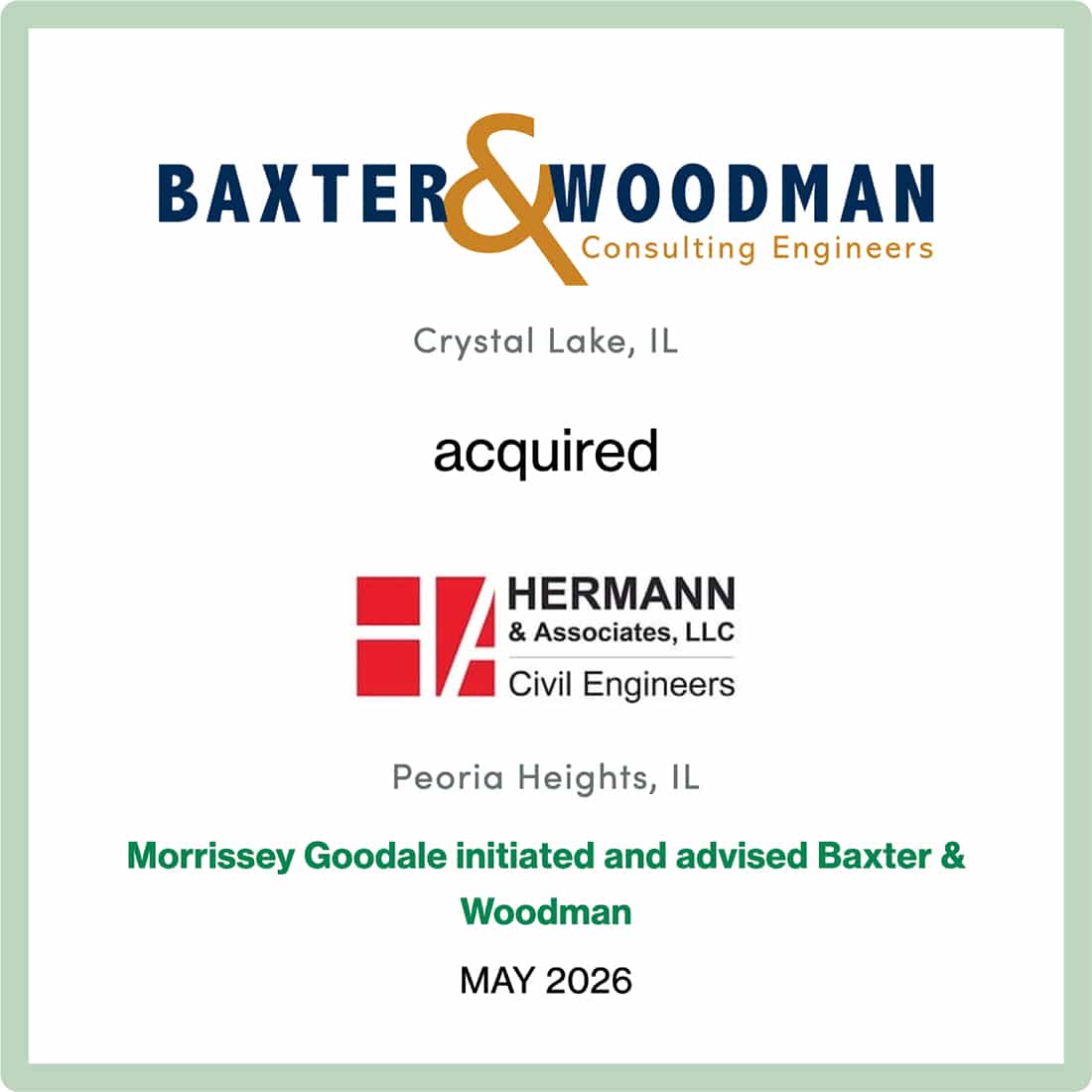
Congratulations to Baxter & Woodman (Crystal Lake, IL) (ENR #265): The infrastructure planning, design, and construction services firm acquired Hermann & Associates (Peoria Heights, IL), a firm with expertise in transportation and infrastructure projects. We’re thankful that the Baxter & Woodman team trusted us to initiate and advise them on this transaction.
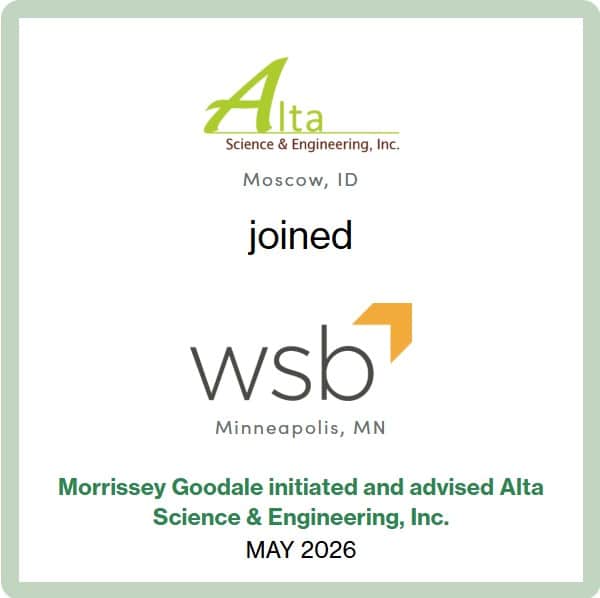
Another congrats to Alta Science & Engineering (Moscow, ID): The science and engineering firm with experience in environmental and infrastructure services joined WSB (Minneapolis, MN) (ENR #106), a national infrastructure engineering and consulting firm. We feel privileged that the Alta team trusted us to initiate and advise them on this transaction.
Thank you from The CEO Symposium: A sincere thank you to the CEOs who joined us in Dallas last week for The CEO Symposium. It was an exceptional 24 hours of meaningful networking and insight as industry leaders shared their perspectives, experiences, and visions with peers from across the industry. Last week we reported a total of six domestic transactions. Internationally, new deals were announced in the UK, Ireland, and Poland. Check out all of the week’s M&A news here.
October 7-9, 2026 | HOUSTON, TX
M&A and Capitalization Symposium
Learn and network with over 100 AE and environmental consulting industry executives, investors, and experts in the most exciting city in the United States.
Learn More
Keep Up to Date with
Industry Insights
Stay up-to-date in real-time.