 Subscribe Now



Word on the street > The AI Trilogy I Never Meant to Write; Return of the King; A CEO Isn’t Supposed to Have All the Answers
Word on the Street: Issue 287
Weekly real-time market and industry intelligence from Morrissey Goodale firm leaders.
The AI Trilogy I Never Meant to Write; Return of the King

J.R.R. Tolkien never set out to craft a trilogy with The Lord of the Rings. He wrote one long book. His publishers, citing post-war paper shortages and the sheer heft of the manuscript, split it into three volumes. The result was one of the most celebrated trilogies in literary history—completely by accident.
I never intended to write three straight weeks in Word on the Street about AI. (Yes, you’re reading this correctly—I’m comparing my writing efforts to those of Tolkien.) But when the industry’s hottest topic meets our new VP of Strategy (who just happens to be named “Rex”), I felt like I had no choice but to write my “Return of the King.” (“Rex,” “King” as in return of—the third book of the trilogy?) I know—it’s beyond a stretch, but I’m running with it.
Four weeks ago, I wrote “Inside the Mind of the CEO: AI Anxiety”—a look at what’s keeping AE industry CEOs up at night when it comes to artificial intelligence. Last week, I followed up with “Three Years In: What We Got Right (and Wrong) About AI in the AE Industry”—a scorecard on the predictions we made about AI back in January 2023. (We actually scored pretty high!) And now here I am, writing a third installment. No paper shortage forced my hand. No publisher made me do it.
But unlike Tolkien, I’m not trying to chronicle the destruction of an ancient evil. I’m trying to understand something more immediate: Why has AI become the single most discussed topic among the CEOs we work with? And more importantly—what should (or can) they actually do about it?
To answer that, I sat down with Rex White, who joined Morrissey Goodale last month as our Vice President of Strategy. Prior to coming on board, he was VP, Business Operations for Trilon Group (Denver, CO). And before that, Rex spent eight years at AECOM (Dallas, TX) (ENR #2) where he served as Global Knowledge Management Lead, Director of Commercial Innovation & Strategy after coming up through the firm’s elite Business Leadership Development Program. In other words, he’s seen the AE industry from the inside, and he’s spent his first few weeks here immersed in conversations with CEOs about where AI is headed. I wanted to get his unvarnished take.
What follows is our conversation.
Mick: Rex, welcome to Word on the Street. Let’s start with the big picture. Is AI actually transforming the AE industry, or are we all just talking about it at conferences while nothing really changes?
Rex: AI isn’t a trend—it’s becoming table stakes. Capability is rising, costs are falling, and adoption is coming for the industry whether firms plan for it or not. The question isn’t if it happens. The question is who adapts their workflows first.
Mick: Fair enough. But here’s what I hear from some CEOs: “We’ve been doing great work for decades. Why would AI change what makes us competitive?” What’s wrong with that logic?
Rex: The floor is rising fast—and “polished output” stops differentiating. Proposals, marketing, research, and a lot of documentation and spec-compliance work are getting easier to produce at high quality and at scale. That erodes one of the industry’s traditional signals of competence. Said differently: More firms will look great on paper.
Mick: So, if everyone can produce a slick proposal, what actually matters?
Rex: Trust, judgment, and risk ownership become the center of gravity. When deliverables get commoditized, differentiation shifts hard toward what can’t be copied: client relationships, engineering judgment in messy real-world conditions, and the ability to make—and stand behind—decisions under uncertainty. Especially in regulated, liability-heavy corners of the profession.
Mick: I’ve heard a lot of CEOs talk about their “proprietary data” as a competitive advantage. Is that real, or is it just something people say to sound sophisticated?
Rex: Proprietary data become the most defensible asset—but only if it’s usable. AI doesn’t create advantage out of thin air; it amplifies what you feed it. Firms with structured, accessible historical project data will compound faster than firms with “stuff everywhere.” The winners won’t be the ones with the fanciest tool. They’ll be the ones with the cleanest foundation.
Mick: Here’s the part that puzzles me. I talk to CEOs who tell me they’re “all in” on AI. They’ve got pilots running. They’ve got task forces. But when I ask what’s changed in the P&L, I get a lot of throat-clearing. What’s going on?
Rex: Most “AI progress” won’t show up in the P&L until firms redesign how work gets done. There’s a gap between pilots and profit in the industry: We see lots of activity, but don’t hear much about verifiable, measurable impact so far. AI value comes when workflows, roles, handoffs, and governance change—not when people merely “use ChatGPT.”
Mick: Let’s talk about something that makes CFOs nervous: pricing. If AI makes us more efficient, do we just…give that away to clients?
Rex: The AE business model is headed for a pricing reckoning. AI decouples time-on-task from value delivered, which stresses time-and-materials and cost-plus models. Firms will feel increasing pressure to price outcomes, scope, and risk differently if they want to capture efficiency gains instead of giving them away.
Mick: Last question (but I think it’s the best one) —and this one’s personal to a lot of the CEOs I work with. They built their careers on the traditional model: You start as a junior, you do the reps, you develop judgment over time. Does AI break that ladder?
Rex: Talent is the sleeper disruption. The traditional staffing pyramid and the experience ladder are under threat. AI can make junior staff more productive, but it also risks removing the “reps” that create future senior judgment. Meanwhile, AI can be confidently wrong—which increases the premium on experienced interpretation and review. Firms that reinvent development, mentorship, and quality control will pull away from the pack.
Mick: Rex, thanks for this. I suspect this won’t be the last time we talk AI. I know it’s going to be the hottest topic at the roundtable discussions that you’re facilitating this week in Dallas at The CEO Symposium.
Rex: Happy to do it. And for what it’s worth—I didn’t expect to join a firm in the middle of an AI trilogy either. But here we are.
And with that, the trilogy concludes. No hobbits were harmed in the making of this series. But a few assumptions about the future of the AE industry may need revisiting.
If you want to continue the conversation on AI strategy, contact Rex White at [email protected].
You may contact Mick Morrissey at [email protected].
A CEO Isn’t Supposed to Have All the Answers

The higher you climb, the fewer definitive answers there are. Early in your career, competence is largely about knowing things like how to solve a problem, how to manage a project, and how to win a client. Then one day you wake up as the CEO and realize most of the important decisions don’t follow a standard recipe.
- Should we expand geographically now or wait another year?
- Should we invest heavily in AI or cautiously experiment?
- Should we recapitalize the firm?
- Should we back our best rainmaker who also happens to leave a trail of emotional debris behind him every time he leaves a project meeting?
Nobody really knows the answers to these questions, and yet everyone still walks into your office expecting certainty.
That disconnect might mess with you more than you’d care to admit.
Particularly in the AE industry, where many leaders rise through technical excellence, there is an ingrained belief that authority means expertise. The structural engineer was expected to know the loads. The environmental scientist was expected to know the regulations. The aviation planner was expected to know the FAA process. Precision and confidence were rewarded while being wrong was not only costly but would often carry life and safety consequences.
But then leadership arrives, and suddenly the biggest issues involve ambiguity, incomplete information, human behavior, market timing, organizational psychology, and macroeconomic forces nobody fully controls. It’s at this juncture when many otherwise excellent CEOs unnecessarily exhaust themselves trying to maintain the illusion that they still have all the answers.
The truth is the best CEOs usually do not have better answers than everyone else. They often just have a healthier relationship with uncertainty.
Your people are more often asking for confidence than certainty.
That statement sounds philosophical, but I’ve watched it play out over and over again in real firms. Many CEOs become answer machines. Every issue lands on their desk, every disagreement requires their ruling, and every strategic question becomes a request for confirmation. Over time, the organization slowly stops thinking independently because everyone learns the safest move is to wait for the CEO’s blessing.
Other CEOs swing too far the other way. They embrace uncertainty so enthusiastically that nobody knows who’s driving the bus anymore. Every conversation becomes “What do you think?” over and over again, and not surprisingly, nothing moves.
Neither approach works.
The practical challenge for CEOs accustomed to getting most things right is learning how to lead decisively without pretending to know it all—but a few mental shifts that look deceptively simple on paper are required to get there.
Shift #1: Stop thinking people expect you to be right all the time.
First, understand that people are often asking for confidence, not certainty. And while those might seem like the same thing, they’re not.
When a senior leader walks into your office saying, “What should we do?”, they are not always expecting you to pull a rabbit out of your hat. Often, they simply want reassurance that the organization can survive ambiguity without panicking.
A calm CEO creates a whole lot of stability. That’s not to say you’re entirely stoic. It simply means demonstrating that uncertainty is manageable. There is tremendous value in a CEO saying something like, “We don’t know exactly how this will play out yet, but here’s what we do know, here’s what we’re watching, and here’s how we’ll make decisions as conditions evolve.” That answer may seem less glamorous than pretending to be an oracle, but it is far more credible.
Ironically, CEOs often gain trust when they stop trying to be certain about everything. AE firms are full of intelligent people with highly tuned BS detectors. You cannot survive decades of project meetings, contractor claims, public hearings, and fee negotiations without developing one. So, when a CEO confidently declares something nobody could realistically know, people may nod politely in the meeting, but afterward the hallway conversations begin.
Shift #2: Stop being a human permission slip.
I’ve come across plenty of CEOs who have unwittingly trained their organizations to become dependent on them. It often starts innocently enough, like when a principal asks for input on a proposal strategy, a PM wants confirmation before a difficult client conversation, or HR asks how to handle a compensation issue. A good CEO naturally wants to help. But eventually, the organization starts sending every unresolved thought to the CEO’s office. What should you do? Return to sender.
One of the most important disciplines a CEO can develop is resisting the urge to immediately answer every question. If you can, you’ll build leadership capacity around you. Distinguish between someone bringing you their problem and someone bringing you their thinking. The latter is how organizations scale.
Shift #3: Make decisions without perfect information or perfect alignment.
There are moments when the CEO absolutely does need to quickly and clearly decide, particularly during periods of instability. In those moments, organizations crave decisiveness. You don’t have time to hold court. The trick is understanding which category the issue falls into.
Some decisions require organizational input because they shape long-term direction, while others simply require someone to make the call so everyone can move forward. Good CEOs get reasonably good at distinguishing between the two.
That distinction matters because many CEOs burn enormous energy trying to achieve impossible precision before acting. They wait for complete information that never arrives or seek universal alignment that never materializes. They keep refining decisions until the opportunity has either passed or mutated into something entirely different.
One of the more uncomfortable truths about leadership is that many major business decisions can’t be judged until years later, and that is why mature CEOs focus less on always being right and more on creating organizations capable of adapting.
It sure is lonely at the top.
Being the CEO can be lonely precisely because everyone assumes you are supposed to know. The higher you rise, the fewer people around you speak plainly. Subordinates often soften concerns, boards project expectations, employees look for reassurance, and clients expect rock-solid composure. As a result, many CEOs quietly carry around the feeling that everyone else has things figured out better than they do. But they don’t.
Most CEOs are managing through uncertainty in real time. The healthier ones simply admit that reality to themselves earlier. And that realization can actually become liberating.
Once a CEO stops trying to perform perfection, they can focus on what actually matters:
- Building strong decision-making processes
- Hiring people who think independently
- Creating clarity around priorities
- Encouraging healthy disagreement
- Remaining adaptable
- Communicating consistently
- Preserving organizational confidence during uncertainty
In practice, leadership becomes less about possessing answers and more about creating conditions where good answers can emerge, and that’s a very different job description than many leaders originally imagined for themselves.
What do the most successful CEOs actually do?
The firms that handle complexity best are rarely the ones with superhero CEOs. Usually, they are organizations where the CEO created a culture of thoughtful judgment, distributed leadership, and practical adaptability. In those firms, people do not freeze every time ambiguity appears. They know how to think, frame decisions, and move without waiting for approval from the C-suite.
Ironically, these CEOs often appear more confident externally precisely because they are less internally obsessed with needing to know everything.
They understand something many leaders eventually learn the hard way—that their job isn’t to eliminate uncertainty. Instead, it’s to help the organization function effectively despite it.
That may not feel as emotionally satisfying as being the smartest person in every room, but it turns out to be considerably more useful and a heck of a lot less exhausting.
Market Snapshot: Construction Employment
Weekly market intelligence for AE and environmental industry leaders.
Construction job growth is getting even bigger in Texas, while the nation’s largest coastal metros are losing momentum.
Released in late April, an Associated General Contractors of America (AGC) analysis of the latest construction employment data from the U.S. Bureau of Labor Statistics found construction employment (not seasonally adjusted) rose in more than half (52%) of 360 U.S. metropolitan areas between February 2025 and February 2026, with three of the five biggest gains occurring in Texas.
The metropolitan regions that added the most construction jobs were:
- Houston, TX (11,200 jobs)
- St. Louis, MO (4,700 jobs)
- Austin, TX (4,700 jobs)
- Charlotte, NC (4,500 jobs)
- Fort Worth-Arlington, TX (3,500 jobs)
On the flip side, construction employment fell in 38% of metropolitan areas, with the steepest losses occurring in:
- New York City, NY (-6,600 jobs)
- Jersey City, NJ-White Plains, NY (-5,200 jobs)
- Los Angeles-Long Beach, CA (-4,800 jobs)
- Riverside-San Bernardino, CA (-4,600 jobs)
For more insights on industry backlogs or questions about our market intelligence and research services, contact Rafael Barbosa.
Access the 2026 AE Industry Outlook Webinar. To purchase the recording and presentation slides, click here.
Word on the Street Podcast Spotlight
Weekly M&A Round Up
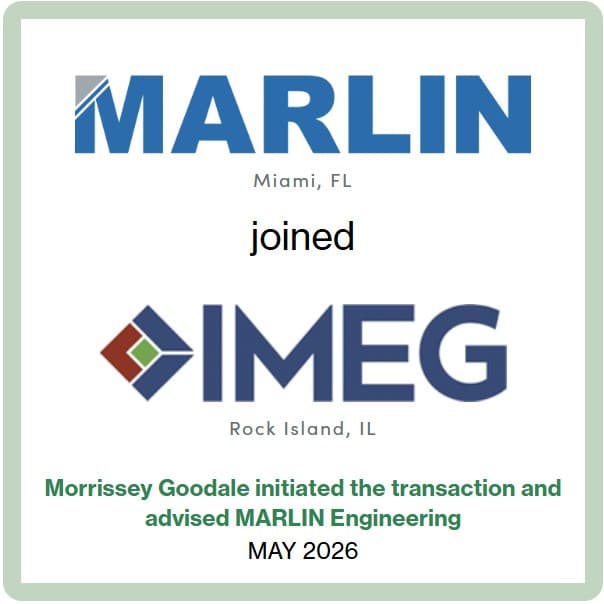
Congratulations to MARLIN Engineering (Miami, FL): The transportation engineering and planning firm joined industry leader and recipient of the 2023 Most Prolific and Proficient Acquirer Award, IMEG Corp. (Rock Island, IL) (ENR #51). We feel privileged that the MARLIN team trusted us to initiate and advise them on this transaction.

Another congrats to Prestige Environmental (Somerset, NJ): The environmental firm joined architecture, engineering, environmental, and planning firm LaBella Associates (Rochester, NY) (ENR #107). We’re thankful that the Prestige team trusted us to initiate and advise them on this transaction.
Featured transactions in FL and NJ highlight the busiest week of 2026: Last week marked the busiest period of 2026 for M&A activity to date, with 18 domestic transactions announced across the U.S., including featured deals in Florida and New Jersey. International deal flow was also strong, with six new transactions reported across the UK, Canada, Denmark, and Australia. Check out all of the week’s M&A news here.
Keep Up to Date with
Industry Insights
Stay up-to-date in real-time.