 Subscribe Now



Word on the street > Inside the Mind of the CEO: AI Anxiety; Are You Ready to Grow Through Acquisition?
Word on the Street: Issue 283
Weekly real-time market and industry intelligence from Morrissey Goodale firm leaders.

Inside the Mind of the CEO: AI Anxiety

Way back in 2023, Word on the Street featured “The CEO’s Diary, August 29, 2032, Reflections on the Past Decade.” The piece envisioned our heroine, the CEO of an ENR Top 100 firm, reflecting on the prior decade with her COO—an AI agent named AI-esha. Here’s an extract:
As we were talking, I realized that probably one of the best decisions I had made was in 2027 when I replaced our previous failing human COO with this wonderful AI version. AI-esha is always available to me. (The former guy claimed that I could always reach him on the golf course—though he never picked up.) She provides me with accurate, real-time, actionable enterprise-wide information when and how I need it. (The former guy could only rarely produce error-ridden (“oh yeah, sorry, I missed that”), color-coded Excel spreadsheets.) Her predictive analytics feature (an extra $3,500 per month) provides me with crystal clear clarity on short- and long-term scenarios for the firm. (The former guy used to give me a 90-day “forecast,” which was always 60 days late.) Plus, she’s got a better sense of humor ($1,000 per month add-on feature), and with the included Empathy option (available free to AE firms of $500-million-plus) I feel like I have a partner who (that?) really wants to understand me and my goals (unlike the former guy who I always figured was being agreeable because he thought he’d get a bigger bonus).
Note to diary: As AI-esha was talking to me, she simultaneously (a) negotiated lease reductions on all of our remaining offices—we’ve reduced our footprint by 90% over the past decade, saving us millions, and (b) acquired the largest environmental firm in Brazil, FirminoFabinho S.A. She was able to achieve both because we sprung for the Legal/Tax/Transaction feature—a bargain at $550 per month.
What the article got wrong: All of the “add on” costs for AI features. They’re accessible with annual subscriptions. (Get the “Gold Package” to be the best CEO you can be.)
What the article got right: The omnipresence of AI in the office of the AE CEO (which includes the CEO and her direct reports) and throughout the firm.
What the article didn’t anticipate: The anxiety levels that AI would create for industry CEOs. The piece described a chummy, trusting relationship between our heroine CEO and her AI agent COO. The current relationship between industry CEOs and AI is far from that.
AI and the early retirement of the AE CEO? In the larger economy, we’re seeing AI impact the careers of CEOs of some of the nation’s largest firms. Earlier this week AIM Media House ran this uplifting article, “AI is Forcing Out America’s Top CEOs,” setting the stage with “Within weeks of each other, the CEOs of two of America’s most iconic companies, Walmart and Coca-Cola, sat down for television interviews and said something almost identical. Both men had led their companies for nearly a decade. Both had overseen billions in revenue, navigated pandemics, and economic shocks. And both had decided, looking at what was coming next, that it was time for someone else to take over. The reason both gave was the same: Artificial Intelligence.” Last month Inc. piled on with an article clearly designed to motivate AE industry CEOs, “AI is Making CEOs Step Down, Too.” Not to be left out, late last year the Wall Street Journal carried “AI’s Next Challenge: Take the CEO’s Job,” which included this line sure to encourage AE CEOs: “What a CEO does is maybe one of the easier things…for an AI to do,” Sundar Pichai, chief executive of Google parent Alphabet, told a reporter recently.”
AI anxiety and the change of the guard: Last month in “Change of the Guard” we wrote about the record number of CEO transitions that are taking place right now in the AE industry. We discussed that one implication of that massive shift at the top of the industry would be faster adoption of AI by younger, more tech-savvy CEOs. “#2. AI for everyone and everything: Retiring CEOs had enough trouble figuring out digital twins, let alone AI. This new generation is 100% plugged in (pun intended) to the imperative of deploying AI in their own roles as CEOs and across the entire enterprise. They’re not seduced by the hype. Nor do they fear the journey ahead. They will give license to the smart young folks at their firms to deploy the technology. They will partner with clients and subconsultants to use AI to drive efficiencies and improve client service.”
AI top of the CEO’s mind: Whether it’s how AI is and will continue to disrupt the AE industry, or how it will retool/remake individual design and environmental consulting firms from the ground up, or if the firm of the near future will be judged by a whole new set of AI-driven KPIs, or if AI makes them a better CEO or a lame duck, or if the advent of AI is a trigger to sell or recapitalize their firm, or what will distinguish industry winners from losers when every firm will have ready access to all of the intelligence and data that they need to make decisions—the topic of AI is the #1 topic on CEOs minds today.
AI and The CEO Symposium: The CEO Symposium is our new in-person symposium exclusively for AE industry CEOs. At the heart of the symposium—surrounded by networking dinners, engaging panel discussions, and receptions—are two series of roundtable discussions. The topics for those discussions are chosen by the 60-plus CEOs in attendance. The #1 topic by a country mile? AI—strategy, execution, and implications.
To connect with Mick Morrissey, email him at [email protected].
Are You Ready to Grow Through Acquisition?
A Straightforward Gut Check for AE Leaders

There’s a point in most AE firms’ lives where organic growth starts to feel a little too incremental. You’re winning work, hiring good people, and churning out a healthy profit. But when you map out where you want to be in five years, the math gets uncomfortable. The gap between where you’re actually headed and where you want to be doesn’t quite close on its own.
That’s usually when acquisitions move from an idea thrown against the wall to a real option—and proponents immediately start pointing to the many upsides, such as access to new markets, added capabilities, strengthened leadership bench, accelerated growth, and the list goes on. But the part that doesn’t get talked about enough is that acquisitions tend to amplify whatever is already true about your firm, whether it’s the good or the not-so-good.
So, the real question isn’t whether to do a deal. It’s whether you’re set up to make a deal work. And that answer can look a little different depending on your firm’s size.
If your firm is under $50M, prioritize focus above all else.
At this level, acquisitions can be incredibly effective, but they work best when they are tight, intentional moves—not broad swings. You don’t need a massive platform. But you do need a firm that’s clear about what it is and where it’s going.
What should be in place
A business you understand
- You know what drives revenue, where margins come from, and where the risks are
Some leadership depth beyond the founders
- Not a huge bench—just enough that everything doesn’t bottleneck at the top
Clarity in your target markets
- Markets, services, and where you win
- The clearer these factors are, the easier it is to spot a strong-fit partner
A realistic sense of financial capacity
- You don’t need a war chest, but you do need to understand how a deal would actually get done
What to be aligned on
- What are we trying to add, specifically?
- How would this make us better within 6-12 months?
- Who is going to lead this on Day 1?
- What kind of firm would feel like a natural fit for us?
Where this goes right
When firms at this level succeed with acquisitions, it’s usually because they:
- Stay close to their core strengths
- Keep the scope manageable
- Put real thought into people and fit, not just revenue
If your firm is between $50M and $100M, you graduate from opportunistic to intentional
This is the weight class where acquisitions often start to feel like a real lever. You likely have more structure, more capacity, and a clearer sense of direction. The opportunity here is to turn that into a deliberate approach.
What should be in place
A business that doesn’t require constant intervention
- Leadership has some room to focus on growth without everything slowing down
A clear, simple growth direction
- Not overly complex—just a shared understanding of what you’re building
An initial view on integration
- How quickly do you bring teams together?
- How do decisions get made post-close?
- You don’t need a playbook (yet)—but you do need a point of view
A capital plan that’s been thought through
- Debt, equity, ownership implications—none of this should be a surprise
What to be aligned on
- What’s the primary goal of acquisitions for us right now?
- What does success look like after a year or two?
- How much integration do we actually want?
- What kinds of opportunities are clearly in—and clearly out?
Where this goes right
Firms in this range tend to do well when they:
- Develop a clear filter for opportunities
- Stay disciplined about what fits
- Treat integration as something to plan—not improvise
If your firm is between $100M and $1B, acquisition is a big part of how you grow
At this level, acquisitions often shift from occasional to repeatable. You’re not just evaluating deals—you’re building a capability.
What should be in place
A defined platform
- Priority markets, services, and geographies are clear
Ownership of the M&A process
- Someone (or a team) is responsible for pipeline, evaluation, and execution
A working integration model
- Not perfect, but tested
- You know how you bring people, systems, and processes together
Clarity on deal structures
- When to use cash, equity, and earnouts—and why
Organizational capacity to absorb growth
- Systems, leadership, and culture can handle new teams coming in
What to be aligned on
- What types of deals fit us best?
- What have we learned from the ones we’ve done?
- How fast can we integrate without creating friction?
- What does “fit” mean for us beyond the numbers?
Where this goes right
- Treating acquisitions as a process, not an event
- Learning and adjusting after each deal
- Keeping an eye on cohesion, not just growth
If you are ENR Top 25 (over $1B), you’re thinking in terms of portfolio
At this level, acquisitions are less about individual deals and more about shaping the firm over time. You’re deciding where to invest, where to expand, and how to position the firm for the next phase.
What should be in place
A clear portfolio view
- Which markets to build, deepen, or enter
Institutional M&A capability
- Dedicated internal resources and external support
Integration at scale
- Systems and processes that can handle multiple or larger acquisitions
Disciplined capital allocation
- Not every deal gets done—there’s a clear rationale behind each one
What to be aligned on
- How does M&A fit into our long-term plan?
- Where does it create the most value for us?
- What kinds of deals are we prioritizing—and why?
- How do we maintain a coherent firm as we grow?
Where this goes right
- Taking a long-term view, not just reacting to opportunities
- Being selective—even with plenty of options
- Keeping strategy and identity aligned as the firm scales
Regardless of size, a few patterns show up consistently. First, firms that know what they’re building and what they’re looking for tend to make better decisions, faster. Second, if the leadership team is not on the same page about why you’re doing this, what you’re looking for, and how it will work, everything gets harder than it needs to be. And third, the deal is just the starting point. The real impact comes from how well things come together afterward.
Before you start actively looking, it’s worth asking: “If we found a strong-fit firm tomorrow, do we have a clear sense of how we’d bring them into the business?” (You don’t have to have every detail down, but enough to move with confidence.) If the answer is “yes,” you’re likely in a good place to begin exploring. If the answer is “we’re getting there,” that’s useful too, but it usually means a bit more alignment upfront will make the process smoother and more effective.
Acquisitions can be a highly effective way to grow, but they tend to reward firms that are clear on what they’re building and disciplined in how they go about it.
Market Snapshot: AE Industry Employment
Weekly market intelligence for AE and environmental industry leaders.

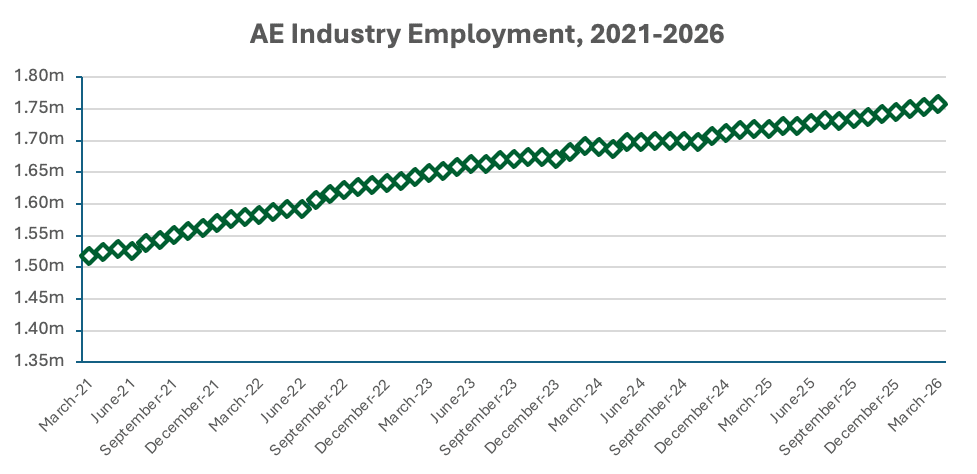
AE industry hiring shows no signs of slowing down, according to newly released data from the U.S. Bureau of Labor Statistics. Architectural, engineering, and related services payroll employment levels reached 1.76 million in March 2026, a gain of nearly 40,000 workers from March 2025.
The 2.3% year-over-year rise in AE payroll employment far outpaced the overall labor market, which rose a scant 0.1% between March 2025 and March 2026, and other major professional services industries. Over the past year, legal services employment increased 1.5%, accounting and payroll services employment remained flat, and advertising and public relations services employment dipped by 1.2%. Construction employment increased by just 0.6% between March 2025 and March 2026.
The AE industry shed 74,000 jobs during the COVID pandemic and took approximately 18 months to recover. Since then, payroll employment has continued to surge, with the industry adding 240,000 jobs over the past five years for a 15.8% gain.
For more insights on industry backlogs or questions about our market intelligence and research services, contact Rafael Barbosa.
Access the 2026 AE Industry Outlook Webinar. To purchase the recording and presentation slides, click here.
Word on the Street Podcast Spotlight

Weekly M&A Round Up

Congratulations to Spheros Environmental (Denver, CO): The ENR #184 ranked environmental firm acquired KP Environmental (Encinitas, CA), an environmental and natural resource consulting firm. We feel privileged that the Spheros team trusted us to initiate and advise them on this transaction.

Another congrats to Corgan (Dallas, TX) (ENR #54): The global architecture and design firm acquired FOX Architects (Washington, DC), a design practice with expertise in commercial architecture and interiors, building repositioning, and mixed-use environments. We’re thankful that the Corgan team trusted us to initiate and advise them on this transaction.
Industry consolidation continues with 14 domestic and global transactions: Last week we reported 11 domestic transactions, including two featured deals in California and Washington, D.C. Additional domestic deals were announced in NY, AL, SD, UT, OH, CO, and IN. Globally, we reported new transactions across the UK and Canada. Check out all of the week’s M&A news here.
Keep Up to Date with
Industry Insights
Stay up-to-date in real-time.