 Subscribe Now



Word on the street > A Manifesto for the AE Industry (Part 2); Beach Reading
Word on the Street: Issue 294
Weekly real-time market and industry intelligence from Morrissey Goodale firm leaders.
A Manifesto for the AE Industry (Part 2)

Welcome to the second installment of our three-part manifesto for the AE industry. Last week in Part 1, we took the wide-angle view of the overall State of the Industry—strong and stable, but with a more nuanced story playing out beneath the headline. This week we zero in on a force reshaping the industry faster than any other: Industry Consolidation and (Re)Capitalization. Next week, Part 3 will be dedicated entirely to Artificial Intelligence.
So, the headline. Industry consolidation is running at record levels. A decade of strong profits, a wave of leadership transitions, and an influx of private equity (PE) have combined to rewrite the capitalization map of the industry. And there’s more change to come.
Where we are today:
- Deal volume is at record highs. Annual transaction counts have more than doubled over the decade, with 2025 being the first year on record with more than 500 completed domestic transactions.
- PE-backed acquirers and/or PE recaps now account for more than half of all design and environmental consulting firm deals.
- The largest firms are increasingly PE-backed, and employee-owned firms are a shrinking share of the ENR Top 100. (See “From True Believers to Deal Signers.”)
- Most sellers are still (relatively) small—72% of 2025 deals involved firms under $10 million in revenue.
- But buyers keep getting larger; the median buyer has nearly doubled in size in five years.
- Serial acquirers—those doing two or more deals a year—have tripled since 2016 and now drive much of the activity. M&A has gone from a periodic event to a core, repeatable growth strategy.
- Valuations keep rising, and scale commands a premium. Firms above $100 million in revenue are seeing values rise fastest.
- International buyers hit record levels, with 50-plus ENR firms sold or recapitalized to overseas interests over the last 24 months.
- For those firms with a “roads and roofs” business model, geographic expansion is a primary deal driver, with Texas and the Southeast the most targeted regions (infrastructure follows population, and so do acquirers).
- AI has entered the M&A conversation (just like it has everywhere else). From deal sourcing to deal diligence and everything in between.
Our outlook—The next 12 months:
- Deal-making will stay near record highs with over 520 transactions this year.
- PE will remain a driving force, with many of the platforms approaching potential exit windows over the next several years.
- Most of those PE exits will be recapitalizations to other PE firms—resetting values higher each cycle. (This is the “Re” in (Re)Capitalization, and it’s often the part of the cycle that surprises first-time sellers most.)
- Large strategic acquisitions will keep growing. Deals for sellers above $25 million have already doubled.
- Valuations will hold firm, especially for scaled, high-growth, lower-volatility firms.
- AI maturity levels in sellers will start to matter more. Acquirers will more and more favor/target sellers that demonstrate a cultural openness to the deployment of AI efficiencies.
And over the next five years:
- Consolidation continues, and the ENR rankings keep reshuffling.
- International and cross-border buyers become a larger force in U.S. deals—call it globalization redux.
- Generational ownership transition keeps feeding a steady supply of sellers.
- The valuation gap between large and small firms widens—scale and market positioning increasingly drive the outcome. (As my colleague David Thornhill likes to say, “In a consolidating industry, being small is not the risk. Being small by default—without a strategy to scale, specialize, or partner—is.”)
- The gap will be even larger between sellers that have “figured out” AI and those that continue to live in the past.
- Smaller firms face mounting pressure to scale, specialize, or partner. Those that cannot keep pace with technology and scale requirements will be far more likely to pursue a transaction.
- For more and more firms, M&A becomes not a once-in-a-career decision but a permanent part of the growth strategy.
Excellence in Acquisitive Growth Awards application window is now open:
Industry consolidation and (re)capitalization continues at pace with implications for employees, project owners, and, of course, shareholders. And that’s why we created the Excellence in Acquisitive Growth Awards series. In doing so we wanted to recognize those acquirers that are in the vanguard, improving how consolidation happens in the AE industry. And we wanted to create a forum to share M&A best practices so that the industry collectively achieves better outcomes in terms of client satisfaction, employee engagement, and value for investors.
The application window is open for two of the three annual Awards: The M&A Best Practices Award and the Best Post-Transaction Performance Award. You can learn more about both of these Awards and how to apply for one or both of them here.
Industry M&A and capitalization are the entire focus of The M&A and Capitalization Symposium in Houston this October. It’s where over 140 AE industry CEOs, corporate development executives, investors, experts, and deal-makers gather to do business in one of the nation’s fastest-growing cities. If you’re thinking about buying, selling, or recapitalizing in the next few years, this is the one event where you’ll meet the buyers, the sellers, and the investors all under one roof. Early-bird registration closes July 31—register now and save.
To connect with Mick, email him at [email protected].
Beach Reading

As summer gets going in earnest, there’s a decent chance you’ll find yourself sitting on a beach sometime over the next several weeks. You can see it now…a prop plane lazily towing a promotional sign for a local restaurant glides under puffy cotton clouds, a sailboat silently inches across the cobalt-blue horizon, and foamy ocean waves lap endlessly on shore. Finally at peace, your eyelids become delightfully heavy.
Then, almost by instinct, you snap back to attention and reach for your phone.
This won’t take long, you say to yourself. You’re just going to quickly scan texts and emails, and maybe briefly check in with the office to see if anything important is going on. You’ll be back in your zen-like state in two minutes.
A half hour later, you’re power walking up and down the beach, head down, staring intensely at nothing, barely aware of your surroundings as you respond to a client, weigh in on a key hire, and dig into why it’s taking so long to close the previous month. You begin to wonder why your vacation somehow feels suspiciously like a Tuesday.
Sound familiar?
If it does, you’re not alone. The AE industry doesn’t stop because the calendar says it’s the week after the Fourth of July. Clients still call, projects still encounter problems, and opportunities still appear unexpectedly. When you own the business, a certain amount of responsibility comes with the territory.
If you can manage to completely unplug from all that, more power to you. But if you can’t, at least know the difference between what genuinely deserves your attention and what merely happens while you’re away.
Not everything is interruption-worthy…
Most CEOs leave town with a nagging question in the back of their minds: “What if something comes up?” It’s a fair concern, but it may not be the right question. A better one is “What kinds of things should come up?”
Without that distinction, everything feels important. A proposal deadline, a staffing issue, an internal disagreement, a client requesting a call, a contract question, or an email asking for “just a quick review” can all feel like reasons to interrupt your vacation. Individually, none seems like much. But collectively, they have a remarkable ability to consume a disproportionate amount of your time away.
To help you avoid this trap, before you leave, spend 15 minutes with your leadership team and establish what circumstances would justify a call. Notice I didn’t say an email, text, or cc. Just a call.
You may find that list to be surprisingly short. It might include a major client relationship that is genuinely at risk, a significant personnel issue, a safety incident, a legal matter, or a critical acquisition decision that truly cannot wait. Almost everything else can survive until you return.
The value of this conversation isn’t just protecting your vacation. It forces the leadership team to distinguish between decisions they can make and decisions they simply prefer not to make.
The siren song of the inbox…
Many CEOs I know tell themselves they check email because they need to stay informed. Sometimes that’s true. More often, they’re checking because uncertainty is uncomfortable.
Unfortunately, the inbox has a way of manufacturing work. One email leads to a reply, the reply leads to a phone call, and the phone call uncovers another issue that wasn’t even on your radar five minutes earlier. An hour later, you’ve solved three problems that almost certainly would have resolved themselves without your involvement.
There’s a difference between staying informed and continually inserting yourself back into the flow of daily operations. Vacation has a way of exposing whether you’re doing the former or the latter.
It’s a test…
Every time you step away, the organization is tested. Can your leadership team make decisions without you? Can they resolve disagreements? Can they exercise judgment? Can they distinguish between an inconvenience and a crisis?
If the answer to every one of those questions is “Let’s wait until the CEO gets back,” then the issue isn’t your vacation. It’s that the firm has become too dependent on one person.
That dependency rarely develops overnight. It usually happens because capable CEOs solve problems quickly, make good decisions, and genuinely enjoy helping. Over time, people become accustomed to bringing every important issue to the top. Eventually, the organization stops developing judgment because someone else has always been willing to provide it.
One of the unintended benefits of taking a vacation is that it creates space for other leaders to lead. Will they make every decision exactly the way you would? Of course not. But if they consistently need you to make the decision, leadership development has stalled.
Let your mind wander…
One thing I’ve noticed over the years is that the best ideas rarely arrive while you’re racing from one meeting to the next. They show up when your mind finally has enough room to wander. When you find it wandering toward work, instead of thinking what emails you might be missing, ask yourself questions that can only be pondered while you’re away from the office:
- If I weren’t already running this firm, would I organize it the same way?
- Where am I spending too much of my own time?
- What decisions should someone else be making by now?
- What is the one thing we need to accomplish over the next twelve months that will matter five years from now?
Maybe it’s during an early morning walk on the beach before everyone else is awake. Maybe it’s sitting on the porch after dinner while the rest of the family is playing cards. Whatever the setting, getting away from the daily rhythm of the business often makes it easier to see the business more clearly.
When you come back…
The measure of a successful vacation isn’t whether you ignored your phone for 10 days. The better measure is whether you returned refreshed, with the business still functioning well, and with the confidence that your leadership team can carry more responsibility than they did before you left.
Market Snapshot: Canada
Weekly market intelligence for AE and environmental industry leaders.
Canada’s economy is showing signs of finally emerging from a wintertime hibernation. After teetering on the brink of a recession, growth is returning and construction activity is trending upwards, with one notable—and enormous—exception.
Battered by inflation, a global energy price shock, and American tariffs and trade uncertainty, Canada’s real GDP contracted 1.0% in the final quarter of 2025 and another 0.1% in the first quarter of 2026. Momentum returned, however, in April, when the economy posted its strongest growth in nine months, prompting forecasts that Canada has dodged a recession.
The Wall Street Journal reported last week that “economists estimate April’s growth and the outlook for May put Canada’s economy on a path toward annualized growth of more than 2%.” TD Economics projects real GDP increases of 1.3% in 2026 and 1.8% in 2027 after a listless 0.7% rise in 2025.
Mirroring the broader economy, Canada’s construction industry endured a frigid start to the year. April brought about a thaw, however, as Statistics Canada noted that construction activity rose for the first time in five months.
ConstructConnect reports that total construction starts through April dropped nearly 40% compared to the first four months of 2025 due to “sluggish nonresidential and civil activity.” It projects that total starts will finish the year down 16.3%. Those numbers, though, are largely weighed down by Ontario, which accounts for 40% of the Canadian construction market. Excluding the country’s most populous province, ConstructConnect expects construction starts to rise this year.
Growth is fastest in the country’s west. ConstructConnect forecasts 2026 construction starts to more than double in Saskatchewan, boosted by a large provincial capital program and commercial investment. It also projects construction starts growth of 22.2% in Manitoba, 12.2% in British Columbia (driven by government investment in highway, energy, and heavy engineering projects), and 7.1% in Alberta where transportation, energy, and technology projects are driving growth.
While a weak residential market is dragging down Ontario’s construction activity, TD Economics reports a sizable provincial capital spending plan is offering a boost. In neighboring Quebec, ConstructConnect forecasts a 6.9% rise in construction starts this year with increases in medical, commercial, and industrial activity.
For questions about our market intelligence and research services, contact Rafael Barbosa.
Word on the Street Podcast Spotlight

Weekly M&A Round Up
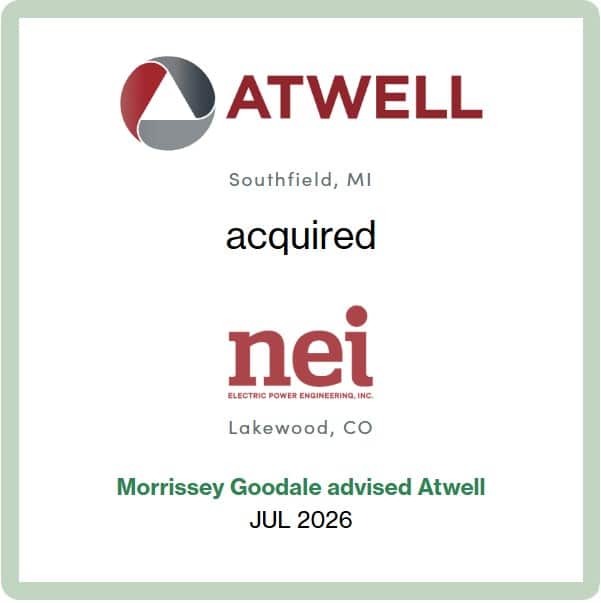
Congratulations to Atwell (Southfield, MI) (ENR #70): One of our “Ten Movers and Shakers to Watch in 2026” acquired NEI Electric Power Engineering (Lakewood, CO), a transmission, substation, and power systems engineering firm with 380 technical professionals. The transaction unites two industry leaders to create an integrated platform for critical power and energy infrastructure. We feel privileged that the Atwell team trusted us to advise them on this transaction.
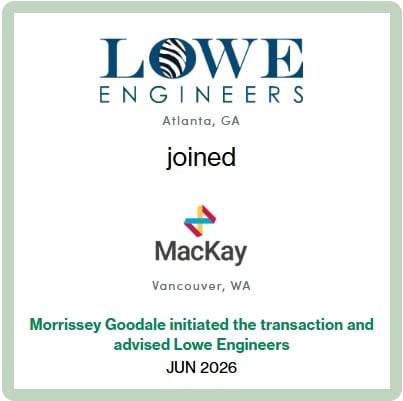
Another congrats to Lowe Engineers (Atlanta, GA): The engineering, land surveying, and geospatial consulting firm with more than 130 professionals joined MacKay (Vancouver, WA), a civil engineering, land surveying, and environmental services firm, establishing MacKay’s first significant presence in the Southeast and a foundation for future growth throughout the region. We’re thankful that the Lowe team trusted us to initiate and advise them on this transaction.
Two featured deals highlight a 12-deal week: Deal activity remained steady last week, with 12 total transactions across domestic and international markets. In the U.S., 11 deals took place across CO, GA, LA, FL, NC, OR, WA, AZ, SC, and TX. Internationally, one transaction was reported in the UK. Check out all of the week’s M&A news here.
October 7-9, 2026 | Houston, TX
M&A and Capitalization Symposium
Learn and network with over 120 AE and environmental consulting industry CEOs, investors, and corporate development executives in one of the nation’s most exciting cities.

Keep Up to Date with
Industry Insights
Stay up-to-date in real-time.