 Subscribe Now



Word on the street > Ten Movers and Shakers to Watch in 2026; Hell Week
Word on the Street: Issue 273
Weekly real-time market and industry intelligence from Morrissey Goodale firm leaders.

Ten Movers and Shakers to Watch in 2026

2025 saw record-breaking M&A activity in the U.S. AE industry, with 509 design and environmental consulting firm acquisitions announced. This was the first year ever that the industry experienced over 500 transactions. These 509 deals represented an increase of 5.0% over the prior year and a 2.6% increase from the record year of 2022 when there were 496 deal announcements. The deal engine continues to run hot, powered by a deep bench of strategic buyers and investors chasing growth, returns, and strategic advantage and a maturing cohort of sellers seeking capital for expansion and ownership transition.
Amid all the consolidation noise last year, 10 fast-growing firms stood out for the number of acquisitions that they made. Today we take a closer look at these 10 Movers and Shakers, which collectively announced 87 deals last year—accounting for a whopping 17% of the year’s consolidation.
1. ZenaTech (Toronto, Canada) (Nasdaq: ZENA): Leading the way with 16 acquisitions last year was this fast-growing Canadian firm. Founded in 2017, ZenaTech went public on the Nasdaq in October 2024 and has since accelerated its growth through acquisition, with management stating that it is ahead of its own expected timeline. ZenaTech aims to tap into the existing network and revenue of government and developer clients, offering modernized drone services and process automation while also cross-selling new products. Last year, the firm primarily acquired surveying firms—seven of which were headquartered in Florida and the rest in AZ, CA, CO, IL, NC, OR, UT, VA, and WA. The firm picked up 180 employees through acquisitions last year.
2. Verdantas (Tampa, FL) (ENR #81): Backed by private equity firm Sterling Investment Partners since 2024, this integrated environmental science, engineering, and consulting firm with 2,260 employees and 99 offices announced 11 acquisitions last year—its second double-digit year. CEO Jesse Kropelnicki described the benefits of acquisitions as “strengthen[ing] Verdantas’ presence in key geographic markets…expanding our team of experts…[and] enhancing our integrated approach.” Verdantas leapt 32 places up the ENR Top 500 list and added almost 400 employees from tech-forward environmental science consulting firms and regional civil engineering practices across CA, CO, ME, NH, NJ, OR, and VA.
3. Consertus (Miami, FL): Backed by private equity firm RTC Partners, Consertus is a global capital program management and advisory firm that officially launched in October 2025 through the acquisition and integration of 10 firms. Integrated firms include OAC Services, Cotter Consulting, KKCS, and Acumenian along with technology additions such as Enstoa and Waycode. The result: a scaled CM/PM engine from New York to Seattle with sector depth in health care, aviation, public buildings, and infrastructure. The firm now stands at over 850 employees and has offices in CA, CO, CT, FL, IL, PR, NY, and WA.
4. Salas O’Brien (Irvine, CA) (ENR #31): Supported by a minority growth investment from Blackstone, employee-owned industry leader Salas O’Brien announced nine acquisitions in 2025. The firm, recipient of Morrissey Goodale’s 2023 Best Post-Transaction Performance Award, is now approaching 5,000 employees—with over 400 employees added from acquisitions last year alone. Focused on providing a broad range of engineering and technical consulting services, Salas O’Brien’s acquisitions added scale in MEP/structural, mission-critical, and facilities engineering. Chairman and CEO Darin Anderson shared “We don’t grow for growth’s sake—we grow to meet evolving needs, expand our capabilities, and create opportunities for our team.” Salas O’Brien welcomed firms based in CA, GA, ID, NC, NM, NY, OH, SC, and TN. Salas O’Brien rose eight spots up the ENR Top 500 this year, continuing its steady climb up the list.
5. Trinity Consultants (Dallas, TX): Trinity Consultants, an employee-owned firm backed by Oak Hill Capital Partners, announced 8 acquisitions that added 573 employees to the firm’s talent pool. Trinity has emphasized growth through acquisition over the last 15 years and received Morrissey Goodale’s 2024 M&A Best Practices Award. Now, over half of its current employees, clients, and revenue come from acquisitions. This year, Trinity notably acquired Jaros, Baum & Bolles (New York, NY), a firm ranked #235 on the ENR Top 500. Additional acquisitions were based in AZ, CA, CT, IL, MA, and OR. Trinity is ranked #66 on the ENR Top 200 Environmental Firms list, having moved up four places since 2024.
6. LJA Engineering (Houston, TX) (ENR #52): Half of LJA’s eight announced deals were in its home state of Texas. Employee-owned industry leader LJA added almost 300 employees to its already impressive roster of talent and crossed the threshold of 3,000 employee-owners in 2025. Through its acquisitions, LJA has maintained a consistent culture and was awarded the #1 Top Workplace by USA Today in 2025. LJA advanced in transportation, land development, water, and survey/geomatics with acquisitions in AZ, FL, NC, and TX. The firm gained 15 places on the ENR Top 500.
7. Atwell (Southfield, MI) (ENR #70): This fast-growing industry leader was a 2025 recipient of Morrissey Goodale’s Best M&A Post-Transaction Performance Award and announced seven acquisitions last year, including two by its subsidiary RVi. In 2025, it announced the largest acquisition in its history—Manhard Consulting (Lincolnshire, IL) (ENR #329)—which Atwell plans to leverage to strengthen its presence in key regional markets. In total, Atwell added over 500 employees in AZ, GA, IL, NC, TX, and WA and climbed a spot on the ENR Top 500.
8. TIC Solutions (Hollywood, FL) (NYSE: TIC): Launched as a rebrand of Acuren after the major merger with NV5 (ENR #26), TIC is a provider of tech-enabled testing, inspection, certification, and compliance (TICC) services and critical asset integrity solutions. Acuren and NV5 collectively completed 6 acquisitions in 2025 and now have a deep bench of talent, with 11,000 employees across 200 North American locations.
9. Pape-Dawson (San Antonio, TX) (ENR #69): Pape-Dawson, backed by Palm Beach Capital, announced six acquisitions in 2025. These acquisitions were focused on growing and deepening service offerings in the Southeast and added over 250 employees to the firm. The firm acquired a trio of Florida-based firms, as well as firms headquartered in GA and KS. Pape-Dawson rocketed 24 places up the ENR Top 500.
10. AKS Engineering and Forestry (Tualatin, OR): A newcomer to this list, AKS is a 30-year old, multi-disciplinary consulting firm providing civil engineering, surveying, natural resources, permitting, planning, and design services to a wide range of private and public clients throughout the Pacific Northwest. The firm recapitalized with Align Capital Partners in early 2025 and subsequently began a series of 6 add-on acquisitions across WA and OR, strengthening its regional presence and growing by over 60 employees.
What’s new with this year’s Movers and Shakers? More than half of these Movers and Shakers have something in common—backing from a private equity firm. We’re seeing these strategic investments accelerate deal activity, with 42% of acquisitions last year involving PE-backed acquirers or flat-out recapitalizations.


Many thanks to Elysa Garcia, Data Manager, and Peter Frank, Research Manager, for compiling all of the information in this week’s article.
You may connect with representatives from this year’s Movers and Shakers at our Southeast M&A and Business Symposium in Miami this March. This year the symposium also features two unique forums for industry CEOs to connect and network—curated CEO Connections Meetings and small-group CEO Networking Dinners.
New for 2026 we’re launching The CEO Symposium in Dallas in May. This invitation-only event is exclusively for industry CEOs, presidents, and board chairs. We’ve designed it to meet the needs of CEOs who want to expand their peer networks, access real-time benchmarking intelligence, and engage with peers on the topics that are important to them.
Connect with Mick Morrissey at [email protected].
Hell Week
A guide to keeping your head when those around you are losing theirs

There’s a special kind of calm that exists in AE firms right before everything goes sideways. It’s that fleeting calm of a Monday morning when you dream of sailing through the week without so much as a minor hiccup.
And then in a flash, the can’t-miss acquisition you just pulled off starts wobbling before the ink is dry, a sudden market shift out of nowhere makes last quarter’s assumptions feel like a fairytale, the only principal on your team without so much as a hint of a succession plan up and leaves, and your friendly neighborhood lender suddenly wants detailed answers that you know you won’t have any time soon.
Welcome to Hell Week, where a good old-fashioned tire fire isn’t even all that unusual. It’s just the job. You’re leading a business where the value your firm delivers is complicated, the timelines are tight, the people are specialized, the clients are demanding, and the margins can be, let’s say, a tad sensitive to surprises.
When chaos hits, the question isn’t whether you can do everything, because you can’t. The question is whether you can do the right things in the right order, without accidentally turning one problem into three more.
The Calm Before the “Oh No”
In calmer stretches, your role is hard in the way that long-distance running is hard—lots of discipline, a little pain, and a healthy dose of manageable suffering. But when the wagon wheels start to come loose, the job becomes something else entirely. It starts to feel like being the only adult on a bus full of middle schoolers when the driver says, “I’m not sure the brakes are working.” In an instant, everyone needs you, everyone has a quick question, and every issue is front-burner worthy. But your value in those moments isn’t that you’re available. It’s that you’re useful. And that means you stabilize the situation, you prevent panic, you correctly prioritize, and you survive the storm. It’s not necessarily heroic, and it’s definitely not glamourous. But it is essential.
First Rule of Hell Week: Don’t Become Another Emergency
Your first job in such situations is not to add to the drama. When something goes wrong, the firm already has a problem, and you don’t need to become another one.
That sounds obvious until you’ve lived it. And if you have lived it, you know things really ignite when you allow yourself to get swept up in the emotion of it all. Maybe you send an email that feels great for 90 seconds and causes pain for 90 days, or maybe you “fix” the situation by showing everyone how disappointed you are, or…well, you get the picture.
But the last thing your firm needs is a second emergency. Instead, it needs your steady hand. Some of the best CEO responses I’ve seen are often boring. They’re calm, direct, and almost annoyingly reasonable. Take, for example, one line that works more often than it realistically should: “Okay. Walk me through the facts first, then we’ll decide what to do.” It’s not that feelings don’t matter. They do. But you can actually operate with facts.
Your Greatest Strength (and Your Most Predictable Trap)
In most AE firms, the CEO is a former top performer. You didn’t get the job because you were “pretty good.” You got it because you were the person people trusted when the stakes were highest. That history becomes a blessing, but also a curse. When all hell breaks loose, your instincts kick in and it can be a short path into the weeds. You start rewriting the email, you join the client call, and you take over the meeting. Ultimately, you do what you do best, and that’s save the day.
Sometimes that’s exactly what the firm needs. But the danger is that you become the firm’s emergency operating system. Every crisis finds its way to you. Every big decision requires you. Every client problem, big and small, needs your presence. And slowly, without anyone intending it, the organization learns to wait for you when something really matters. Good luck getting yourself out of that trap. If you are constantly rescuing your firm, you’ve trained your firm to need rescuing.
So, the goal isn’t to never step in. The goal is to step in strategically, meaning that you first stabilize things, then you build capacity and capability so next time the firm doesn’t require your heroic intervention.
The Three Jobs You Actually Have in a Crisis
When the bottom falls out, you can simplify your role into three core responsibilities:
First, stabilize the situation (not fix everything). Your people don’t need you to be optimistic, but they need you to be clear. That means determining what happened, what’s at risk, what’s going to be done next, and who owns what. Don’t worry. That kind of clarity doesn’t create fear. But vagueness certainly does.
Second, protect the firm’s attention and energy. Unfortunately, panic spreads a lot faster than facts. Preventing emotion from turning the week into a meltdown is, for the lack of a better term, a pretty important job.
And third, decide what gets your attention. You have limited time and limited bandwidth, but unlimited demand. If you try to treat everything as equally urgent, you’ll be fighting on multiple fronts and losing ground on all of them.
Performing Triage: What’s Fatal vs. What’s Just Loud
Here’s a simple way to sort the chaos when it’s coming from all directions:
Tier 1: Things that can kill the firm.
- Cash flow threats
- Major client relationship blowups
- Legal/regulatory issues
- Catastrophic project failures
- Safety incidents
- Reputation events that spread beyond the job
These issues deserve your immediate attention.
Tier 2: Things that can cripple performance
- Key leader departures
- Serious staffing gaps on major work
- PM failures that risk repeat problems
- Internal conflict that’s interrupting value creation
These deserve your attention quickly, but not necessarily personally.
Tier 3: Things that are loud but not lethal
- Complaints that feel urgent but aren’t
- “We need a decision today” when you don’t
- Drama disguised as operations
- Problems that exist because someone wants you to do their job
These likely need structure, but not your full presence.
By labeling the issue, you can better control the response.
Your Hell Week Plan
Make your hell week plan a short one. I’ve observed more than a few CEOs making the mistake of creating a comprehensive plan that tries to solve everything at once. You’d have better luck fixing a leak in your car’s radiator while barreling down the highway.
Instead, refer to these three lists:
List 1: What must be true by end of day (cash is protected, the client call is made, the team is aligned, the risk is contained).
List 2: What must be true by end of week (the firm’s largest project is back on track, the staffing plan is in place, the root cause is identified, the client is satisfied).
List 3: What can wait (which is most everything else that isn’t on List 1 or List 2).
I Always Feel Like Somebody’s Watching Me
When all hell breaks loose, your people watch for signals in how you respond, what you prioritize, who you protect, whether you stay calm, whether you turn on your team, and most importantly, whether you tell the truth.
In those moments, your behavior becomes the firm’s behavior, and that’s the real weight of the job.
Market Snapshot: Alaska and Montana
Weekly market intelligence for AE and environmental industry leaders.
50 states in 50 weeks – This series leverages our market intelligence database to bring you powerful AE industry insights. Each week, we highlight new states in green while previously featured states fade to a lighter green. Next, let’s look at Alaska and Montana.
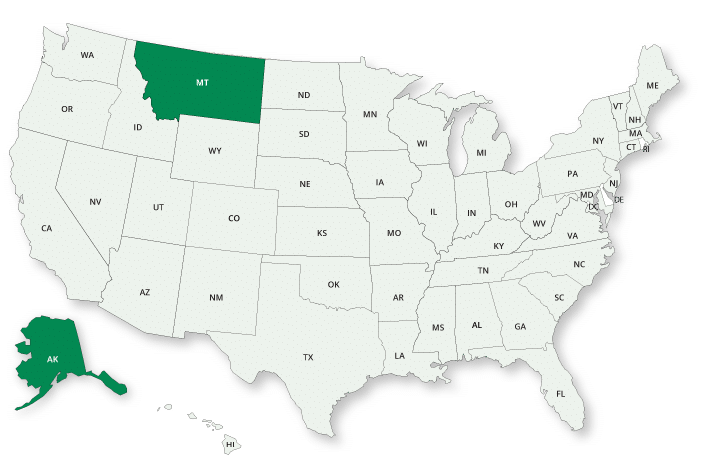
Alaska Economic Performance and Outlook Grade*: C
- Economy: C
- Population: D
- Workforce: C+
- Financial/Fiscal Health: A-
* Overall grade is assigned based on a curve (relative to all states’ performances).
The largest state in land area, Alaska has the country’s third-smallest population and economy. Energy remains vital to the state economy, and the Trump administration is rolling back drilling and mining regulations and opening over 1.5 million acres in the Arctic National Wildlife Refuge for oil and gas leasing. Federal spending is another major driver, with capital spending surpassing an all-time high of $2 billion annually in four of the past five years. According to the Associated General Contractors of America, Alaska’s construction spending is split nearly evenly between the public and private sectors. The economic outlook for 2026 is stable, according to Alaska Business, while ConstructConnect ranks The Last Frontier third nationally in forecasted construction starts through 2029. Long-term demographics are challenging, especially in southeast Alaska where one study projects a 17% population drop by 2050. Major projects include the 211-mile Ambler Road, U.S. Coast Guard base upgrades in Kodiak, the Nome deepwater port, and a proposed $45 billion LNG treatment, carbon sequestration, and 800-mile gas pipeline project to link the North Slope to Anchorage.
Montana Economic Performance and Outlook Grade*: B
- Economy: C-
- Population: C+
- Workforce: B
- Financial/Fiscal Health: B
* Overall grade is assigned based on a curve (relative to all states’ performances).
Although it has slowed recently, Montana experienced a dramatic population surge during the COVID-19 pandemic, with only Idaho growing faster between 2020 and 2021. Rapid in-migration to cities such as Billings, Bozeman, and Missoula has exacerbated long-standing housing shortages and driven demand for infrastructure and commercial projects. With low unemployment, Montana has boasted the sixth-fastest growing economy since 2019, according to the U.S. Bureau of Economic Analysis. As a result, Montana ranked fourth nationally in construction spending growth between 2019 and 2023. A cornerstone of the Treasure State’s economy, construction accounted for 8.7% of statewide private-sector jobs in 2023, the fourth-highest percentage in the U.S., according to the U.S. Bureau of Labor Statistics. The Montana Department of Labor & Industry forecasts construction to be the state’s largest job-creation contributor through 2033, expanding 2.3% annually. Dodge Data & Analytics projects the value of new construction starts in Billings to climb 24% in 2026, propelled by a doubling in electric utility starts.
For sector-specific data and insights for Alaska or Montana or questions about our market intelligence and research services, call/text Rafael Barbosa at 972-266-4955 or email [email protected].
Join us February 24 for the 2026 AE Industry Outlook Webinar where we’ll unpack the trends shaping the industry and provide a sharp view of market opportunities. Click here for registration and details.
Weekly M&A Round Up
Two new deals in the Southeast; 12 additional domestic transactions this week: Industry consolidation is gaining momentum in the Southeast and across the country, with 14 new transactions announced last week, including two transactions in Florida and South Carolina. Additional domestic deals were announced in ME, NM, MS, CA, TN, MA, IL, MI, and VA. We reported nine additional transactions in Australia, Canada, Denmark, the UK, and Norway. Check out all of the week’s M&A news here.
October 7-9, 2026 | Houston, TX
M&A and Capitalization Symposium
Learn and network with over 120 AE and environmental consulting industry CEOs, investors, and corporate development executives in one of the nation’s most exciting cities.


Feb 24, 2026 | webinar | 12:30-1:30PM EST
2026 AE Market Intelligence Webinar
Gain access to Morrissey Goodale February 24, 2026 AE Market Intelligence Webinar to explore the trends shaping the industry and gain a clearer view of where opportunities are emerging—and where conditions are tightening.
Keep Up to Date with
Industry Insights
Stay up-to-date in real-time.