 Subscribe Now



Word on the street > Inside the Mind of a Departing Founder; It Starts Long Before the Sale
Word on the Street: Issue 296
Weekly real-time market and industry intelligence from Morrissey Goodale firm leaders.
Inside the Mind of a Departing Founder

Firm founders are species unto themselves. Each one a unique, shape-shifting Venn diagram of owner, leader, manager, technical expert, project manager, administrator. At the beginning of a firm’s life, they are all of these functions at the same time. As the firm grows, their roles change. They tell themselves that they are “focusing on their highest and best use,” but you’ll often find them taking out the trash, fixing the office microwave, or deciding the playlist for the annual all-employee meeting.
Collectively, founders are an exclusive club. A special subset of the AE industry’s overall leadership. And an important one at that. To this day, even after waves of consolidation and rebranding, some of the industry’s most iconic firms bear the names of their founders. Many of the technical and business innovations that have reshaped the industry have resulted from the bravery, creativity, vision, and innovation of firm founders.
I’ve spent a good deal of my career working for professionals who started AE and environmental consulting firms. Most have served as inspirations for me, but some quite frankly have been dour, deflating. (It takes all sorts.) Not all of them are entrepreneurs in the classic sense. They’ve not been universally wired to scale their businesses. For those who were driven to grow, they provided me with some of the most rewarding and exciting advisory engagements as our team helped them grow stronger and better, delivering more value for clients and creating terrific opportunities for employees. At the other extreme were founders who were happy to see their firm reach $5 million in revenue and extract $3 million in compensation annually—for 20 years. Many never have had, and never will have, a written mission or vision statement for their firm. However, I’ve found them to share a certain shared wiring: relentlessly optimistic, allergic to bureaucracy, ferociously protective of their firms, doggedly determined (I know that one sounds like a cliché, but it’s 100% true), and congenitally incapable of suffering fools.
From day one, founders set the tone for their firms. They are the walking embodiment and example of their enterprise’s culture, its ethos. They provide the creativity, capital, and commitment to make it through the first, fifth, and tenth years (that first decade goes in the blink of an eye). They work the long days and longer nights, sacrifice family and leisure time, push themselves in ways they never imagined, create something out of nothing to ensure that every client is more than satisfied. When things go bad—a client goes bankrupt and blows an irreparable hole in the balance sheet because they are unable to pay, or the economy goes south and work dries up, or that project manager who appeared to be super reliable flakes out and hightails it out of town leaving a massive mess on a project—founders know there is no one coming to save them, nobody else to “take care of things.” It’s all on them. The lucky have a partner or partners who complement them—amplify their strengths, nullify their weaknesses, share the burden with them. But many, many founders only have themselves.
Some founders never leave. They die on the job with no transition plan in place. After 10, 15, or 20 years, however, most founders face the decision to transition their firm—either internally or externally. Some of the most intense and meaningful consulting engagements of my career have involved advising founders through those transitions. Through those conversations—like ones that last late into the evening after a fraught meeting with a buyer or the calls that come over the weekend when it looks like an internal transition is on the rocks—I’ve been privileged to get inside the minds of many a founder at that most critical of times in their professional careers and for their firms.
Here are some of the things that I’ve learned from those conversations…
- Most founders didn’t start their firms to sell it—and most never think about their exits at all. Almost nobody launches a firm with a liquidity event in mind. The origin story is never “I want to build something valuable and cash out in 25 years.” It’s “I couldn’t stand working for my old firm,” or “I knew I could do it better,” or “They laid off my mentor, and I was next.” Exit strategy is a phrase that belongs to other people. The consequence of this shows up decades later. A founder who has spent 30 years never once seriously contemplating how “this” ends often arrives at the most important financial decision of their life with no plan, no framework, and no idea what the firm is actually worth. The good news is that it’s fixable. The bad news is that most founders don’t start thinking about it until the referee is about to blow his whistle.
- Very soon after launching, most founders never want to work for anyone ever again. Independence is such a sweet, sweet feeling. Once you’ve tasted setting your own strategy, hiring your own people, and answering to no one but your clients and your conscience, going back to a chain of command—even the most benign one—becomes unthinkable. This is charming—right up until it becomes the single biggest obstacle to a successful transition. Because selling the firm, whether internally to the next generation or externally to a strategic or private equity buyer, almost always means answering to someone again. An internal transition means ceding real control to people who will do things differently. An external sale means a new parent, an earnout, an integration plan, and—yes—a boss with a spreadsheet (or some new-fangled AI-powered app that does everything that a spreadsheet can do and nothing more but is way more expensive). The very independence that made the founder successful becomes the hardest thing they’ll ever be asked to give up. I’ve watched more than one deal die not over price, but over the moment a founder truly absorbed that “sold” also means “reports to.”
- Many founders are deeply ambivalent when the moment for an external sale finally arrives—ready to leave and unwilling to let go, both at once. They’ve earned the exit, they know in their head that it’s time, and a real part of them genuinely wants it. And yet another part cannot picture a Monday morning that doesn’t start at the firm. For decades the firm has been the organizing principle of their days, their identity, their sense of purpose—and that connection doesn’t simply switch off the day the papers are signed. Deep down many founders worry that an external buyer—which more and more these days is private equity-backed—don’t “get” what the firm is all about. Don’t quite have the judgment, the relationships, or the understanding of the firm’s history, what really made it what it is today. In reality, the best buyers only need to understand the “elevator speech” about the firm’s history. What’s 100 times more important is that the buyer understands the brand equity and its potential. Many founders fail to understand this, which makes it harder for them to fully embrace the transition. So, they want to leave and to stay—a feeling that’s in my experience unique to the founder class. The healthiest transitions give that “founder ambivalence” somewhere useful to go; the unhealthy ones let it curdle into second-guessing that pollutes the groundwater.
- Founders without children often have the hardest time letting go—internally, and especially externally. Here’s one that rarely makes it into the succession-planning binder but shapes more decisions than any financial model. For a founder with no kids, the firm frequently becomes a proxy for their child—the legacy, the thing that carries their name and their values forward. Selling it, especially to an outside buyer, can feel less like a transaction and more like handing off a member of the family. This complicates both paths. An internal transition means entrusting the “child” to people who may not raise it the way the founder would. An external sale means giving it to strangers entirely. I’ve sat across the table from founders whose numbers pointed unambiguously toward a sale and whose hearts simply would not let them sign. Without literal heirs, the stakes paradoxically climb—there’s no next generation to inherit the firm and no family story to pass it down, so the firm becomes the whole legacy, and letting go of it means letting go of the legacy itself.
- Most founders want to “do right” by their non-founder partners—but very few get the balance right. Almost every founder I’ve met genuinely wants to take care of the people who helped them build the firm. The instinct is admirable. The execution is where it goes sideways, and it tends to go sideways in one of two directions. Some are too generous—handing out or gifting equity, diluting themselves early, and creating a set of expectations the firm can’t sustain when growth slows or the buyout obligations come due. Others are not generous enough—holding the equity close, keeping the real upside for themselves, and then wondering why their best people keep leaving for a competitor or a PE platform that offered them a piece of the action. The narrow band in between—generous enough to keep the band together, disciplined enough to keep the firm fundable—is where the truly great founders live. Precious few find it. And the ones who don’t usually discover, too late, that the partners they under-rewarded or over-promised are the same partners who determine whether an internal transition succeeds or the firm even makes it to a sale in one piece.
Over 140 AE industry founders, CEOs, corporate development executives, and investors will gather for The M&A and Capitalization Symposium at the five-star Post Oak Hotel at Uptown Houston this October. This third of our three annual symposiums is specifically designed exclusively for decision-makers whose priorities include their firm’s successful capitalization or recapitalization or growth through M&A. Early-bird registration is available through July 31.
You can reach Mick Morrissey at [email protected].
It Starts Long Before the Sale

If you’ve owned your firm for any length of time, there’s a good chance the thought has crossed your mind.
Maybe it happens after a board meeting. Maybe it’s during a long drive home after visiting a branch office. Or perhaps you’re sitting on the porch on a Saturday morning with a cup of coffee, wondering what the next 10 years of your career might look like.
Somewhere along the way, a simple question enters your mind…“I wonder what the firm is worth.”
Just because the thought crept into your mind doesn’t mean you’ve decided to sell. It doesn’t even mean you want to. More often than not, it simply means you’ve entered a different stage of ownership. You’re beginning to think less about the next project, the next office, or next year’s budget and more about the long-term future of the business, your partners, your employees, and yourself.
The mistake many owners make is assuming that once this question surfaces, the next step is to start thinking about buyers. It isn’t. The first step has nothing to do with buyers at all. It has to do with deciding whether exploring a transaction even deserves your time and attention.
What are the right questions to ask? Most owners naturally begin by asking, “Should we sell the firm?” That’s actually a difficult question to answer because it assumes you’ve already narrowed the conversation to one possible outcome. A better question is, “Should we spend some time exploring whether selling makes sense?”
Those two questions sound similar, but they lead to very different discussions.
The first forces people to take sides almost immediately. The second simply gives the ownership group permission to learn. It creates room to gather information, challenge assumptions, and consider alternatives without feeling like anyone has already committed to a particular path.
That distinction matters because the best ownership groups don’t stumble into transactions. They work through them deliberately.
Who should be around the table? The people who should participate in these discussions will vary from firm to firm. In some organizations, it may be a single owner. In others, it may include the board, the ownership group, or both. The important thing is making sure the right voices are part of the conversation before assumptions harden into decisions.
If you’re the sole owner, the decision is both easier and harder. It’s easier because you don’t need consensus. But it’s harder because you don’t have partners challenging your assumptions. It becomes easy to confuse being tired with being ready or to let one particularly difficult year influence what should be a long-term decision. That’s why many sole owners benefit from bringing in trusted outside perspectives long before they need advice on valuation or deal structure.
If your firm has a majority owner, a controlling board, or another governance structure that ultimately directs major decisions, it’s imperative that the appropriate people are brought in early enough to ask the right questions, challenge assumptions, and evaluate the alternatives, regardless of who initiates the discussion.
Equal ownership groups face a different challenge altogether. In many firms, everyone is waiting for someone else to raise the subject first. Nobody wants to appear disloyal to the firm or signal that they’re ready to leave. As a result, conversations that should begin five years before a potential transaction often begin eighteen months beforehand. Valuable options quietly disappear simply because nobody was comfortable asking the first question.
Know what success looks like. One of the most revealing conversations an ownership group can have has nothing to do with valuation. Instead, ask each owner to describe what success would look like three years after a transaction.
Some may immediately talk about financial security. Others may describe opportunities for employees, expanded capabilities, or access to capital. Some may want to continue leading the business, while others are already imagining life after full-time work.
Those differences matter.
It’s surprisingly common for ownership groups to spend months discussing what happens on closing day while spending very little time discussing what happens on day one after closing. Yet that is the life everyone will actually be living.
If the ownership group can’t describe what a successful future looks like, it’s probably too early to evaluate whether any transaction can deliver it.
You’ll know when you’re ready. Owners often ask when they should begin seriously exploring a transaction. There isn’t a perfect moment, but there are usually signs that the conversation has matured.
The ownership group understands why it’s exploring the idea rather than simply reacting to industry headlines, and there is broad alignment around the firm’s long-term objectives. Perhaps most importantly, the discussion has shifted away from whether someone is burned out and toward what is genuinely best for the firm and its people.
Those are healthy conversations.
There are also warning signs that suggest the process should slow down:
- One owner wants to exit while everyone else wants to continue.
- The firm’s leadership succession remains unresolved.
- Nobody has discussed post-transaction roles.
- The expectation is that a buyer will solve internal leadership or performance problems.
- The primary motivation is simply that “the market seems hot.”
Transactions rarely fix organizational issues that existed beforehand. More often, they expose them.
Before you take the next step, think it through. The best transactions I’ve seen didn’t begin because someone suddenly decided it was time to sell. They began because an ownership group was willing to step back from the daily demands of running the business and have an honest conversation about the future.
- What do we want our lives to look like?
- What do we want this firm to become?
- What responsibilities do we have to our employees?
- Which path gives us the best chance of accomplishing those goals?
Sometimes these conversations lead to a renewed commitment to independence. Sometimes they strengthen an internal transition plan. Sometimes they reveal that the firm isn’t ready yet (and that’s a valuable conclusion in its own right). And sometimes they result in a sale. The important thing is that the decision is intentional.
If you’ve recently found yourself wondering what the firm might be worth or what the next chapter could look like, don’t feel pressured to jump to conclusions. You’re not deciding whether to sell. You’re simply deciding whether it’s time to begin asking better questions.
For most firms, that’s exactly where the journey should begin.
Market Snapshot: BUILD America 250 Act
Weekly market intelligence for AE and environmental industry leaders.
An initial draft of the legislation replacing the current U.S. surface transportation law—which expires September 30, 2026—would modestly increase highway and bridge funding but impose double-digit cuts to transit and passenger rail investments.
The BUILD America 250 Act authorizes approximately $580 billion over five years, including $474 billion in guaranteed funding from the Highway Trust Fund and $106 billion contingent on future General Fund appropriations. The roughly 1,000-page legislation approved in May by the U.S. House of Representatives Committee on Transportation and Infrastructure by an overwhelmingly bipartisan 62-2 vote includes the following guaranteed funding:
- $376.0 billion for the Federal Highway Administration
- $87.7 billion for the Federal Transit Administration (FTA)
- $5.7 billion for the National Highway Traffic Safety Administration
- $5.0 billion for the Federal Motor Carrier Safety Administration
The $106 billion in non-guaranteed funding includes:
- $64.7 billion for the Federal Railroad Administration
- $15.0 billion for the FTA’s Capital Investment Grants Program
- $10.0 billion for the Competitive Highway Bridge Program
- $10.0 billion for the freight and multimodal Mega Grant Program
- $6.0 billion for the Infrastructure for Rebuilding America program
According to the American Road and Transportation Builders Association, the BUILD America 250 Act would boost highway formula programs by more than 3% over the current Infrastructure Investment and Jobs Act in the first year with more modest growth to follow. The American Public Transportation Association reports, though, that the bill contains a potential 15% cut in overall transit funding and 43% reduction in passenger rail investment.
The BUILD America 250 Act includes new Highway Trust Fund revenue for the first time in more than 30 years with a requirement that states collect annual registration fees of $130 for electric vehicles and $35 for plug-in hybrids. The Congressional Budget Office estimates the measure would generate roughly $12 billion in revenue over 10 years—far short of what’s required to avert the Highway Trust Fund’s looming insolvency. The fund is projected to run out of money by mid-2028 as fuel efficiency improvements and electric vehicle sales erode collections of fuel taxes, which have remained unchanged since 1993.
While the bill has overwhelming popular support—78% of U.S. voters want Congress to pass a new bill before the current law expires, according to a poll released by the Associated General Contractors of America (AGC)—passage of new legislation before the end of September is unlikely. Given the legislative backlog facing Congress and prior history of reauthorizations, a temporary extension of the current transportation law will likely be needed.
For questions about what the BUILD America 250 Act might mean for your firm and about our market intelligence and research services, contact Rafael Barbosa.
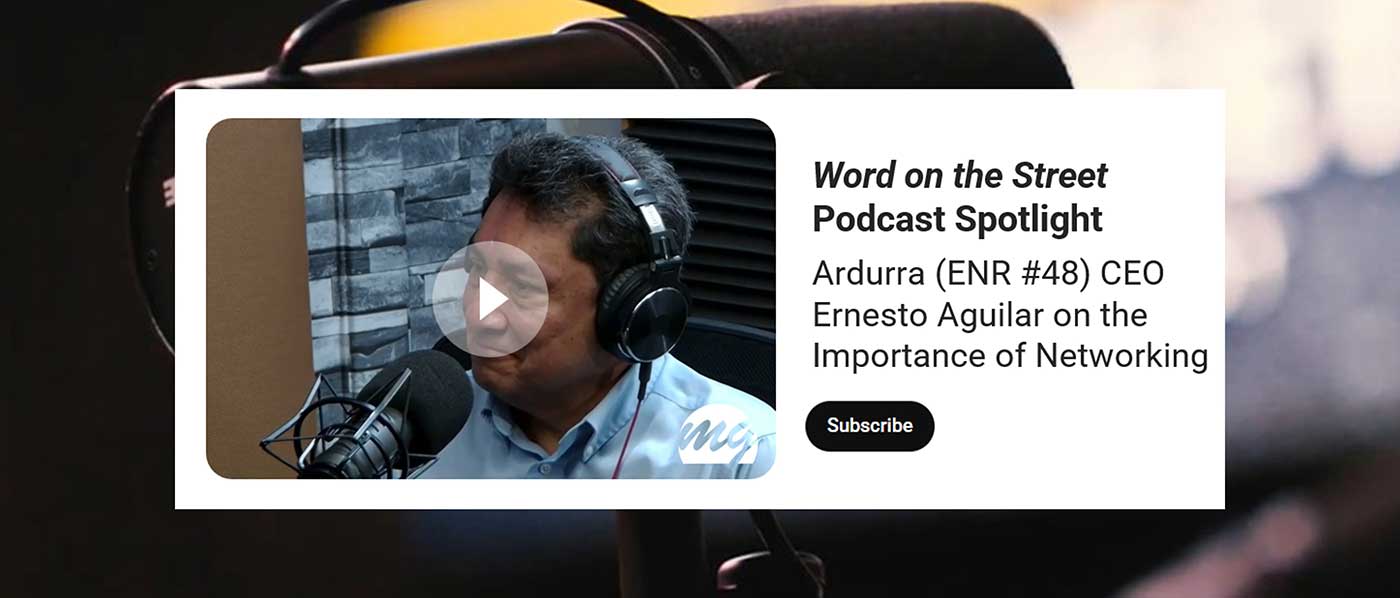
Word on the Street Podcast Spotlight
Weekly M&A Round Up
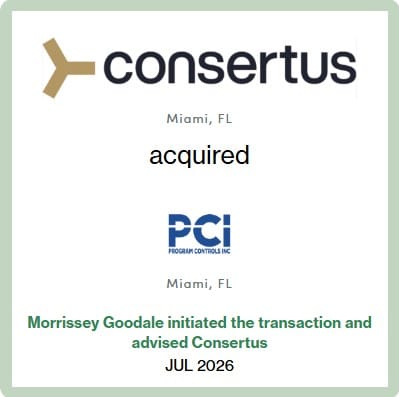
Congratulations to Consertus (Miami, FL): ENR’s #22 ranked CM/PM-for-fee firm acquired Program Controls Inc. (PCI) (Miami, FL), an engineering firm with experience in the aviation, water, port, transportation, education, and commercial sectors. We feel privileged that the Consertus team trusted us to initiate and advise them on this transaction.
Another congrats to Salas O’Brien (Irvine, CA) (ENR #31): The recipient of the 2023 Best M&A Post-Transaction Performance Award merged with Sigma Engineered Solutions (Raleigh, NC), a firm providing MEP, fire protection, and telecommunications engineering design services. We’re thankful that the Salas O’Brien team trusted us to initiate and advise them on this transaction.
Florida and North Carolina headlined last week’s M&A Update: Last week’s M&A activity totaled nine transactions across domestic and international markets. Seven of those deals were based in the U.S., spanning FL, NC, MN, TX, NY, AZ, and SC. On the international front, two transactions were reported in the UK and Germany. Check out all of the week’s M&A news here.

The M&A and Capitalization Symposium
Learn what’s new (and next) in the world of AE M&A and Capitalization, make valuable new connections with industry leaders, and gain practical insights at the Post Oak Hotel at Uptown, Houston, TX.

The Top 5 M&A Questions CEOs Are Asking in 2026
Explore the five critical questions driving M&A strategy, valuation, and ownership decisions across the AE industry in 2026—and gain the answers and insights you need to make smarter M&A decisions.
Keep Up to Date with
Industry Insights
Stay up-to-date in real-time.